Water supply systems form the backbone of any developing region whether it’s a fast-growing city, an industrial zone, or a rural village. A well-planned water supply design ensures consistent delivery, maintains water quality, and supports long-term sustainability.
With increasing demand and infrastructure expansion across India, the focus has shifted toward smarter, more efficient approaches in the planning and design of water supply system. This involves not just engineering calculations but also practical considerations such as terrain, population growth, and future scalability.
Understanding the Structure of a Water Supply System
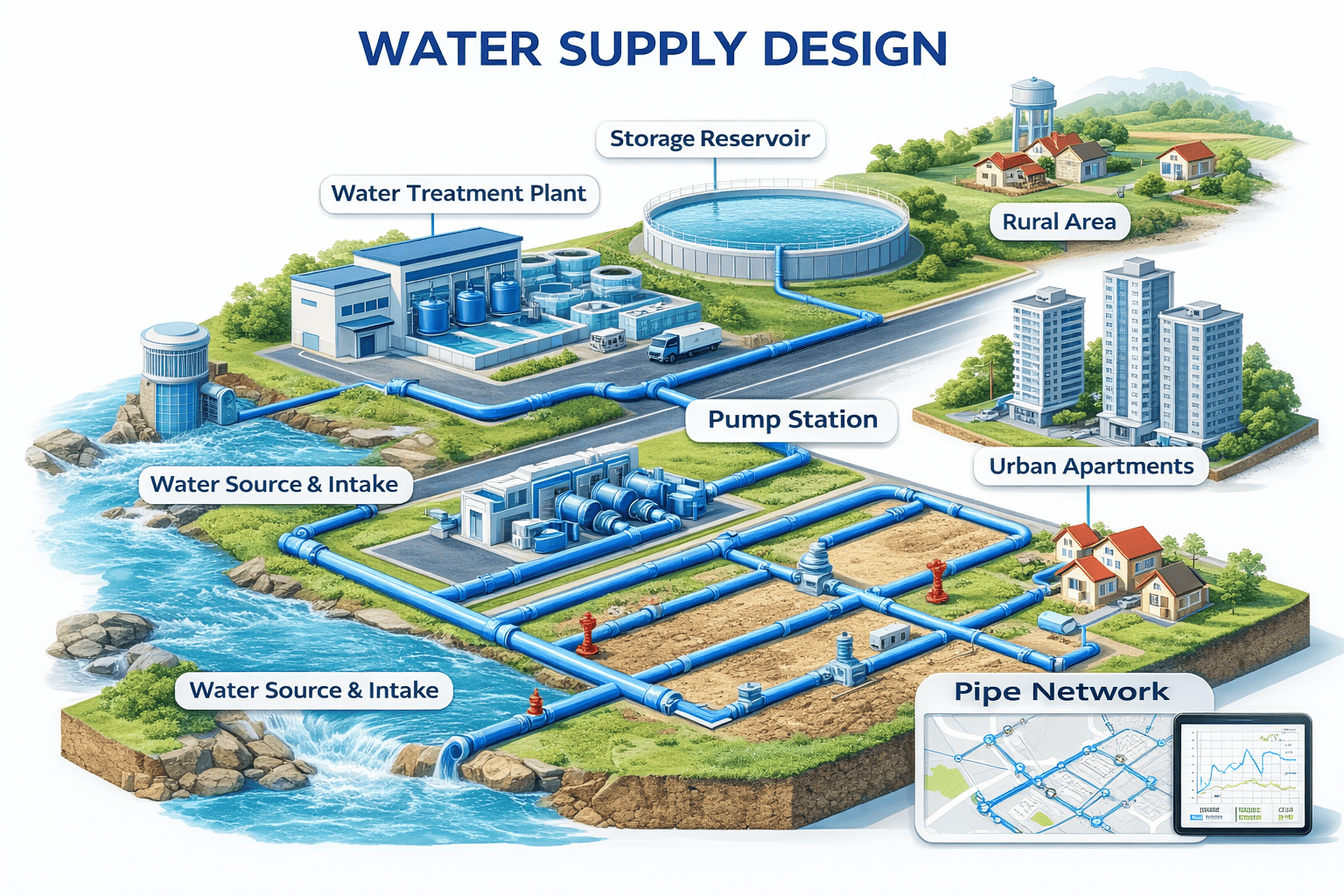
The design of water supply system is about moving water from its source to the end user safely and efficiently. The process usually begins with identifying reliable sources like rivers, reservoirs, or groundwater.
Once the source is confirmed, engineers move toward developing a design of water supply project that includes treatment, storage, transmission, and distribution. Every stage is interconnected, and even a small design flaw can impact the entire system.
Distribution System: The Heart of Water Supply
One of the most critical aspects is the design of distribution system in water supply, as it determines how water reaches households, industries, and public utilities.
The design of water distribution system must ensure:
- Uniform pressure across all areas.
- Minimal water loss.
- Reliable supply during peak demand.
Effective water distribution design balances technical calculations with real-world challenges such as uneven terrain and varying consumption patterns.
Pipe Network Design and Layout
The efficiency of any system largely depends on the design of pipe network for water supply. Engineers must carefully decide pipe sizes, materials, and layout to reduce energy loss and ensure durability.
A well-planned design of water supply pipe networks minimizes leakages and simplifies maintenance. Similarly, both water supply pipe line design and water supply pipeline design focus on optimizing flow while keeping installation and operational costs under control.
When all elements come together, they form a comprehensive water network design that supports long-term functionality and scalability.
Importance of Hydraulic Design
Hydraulic calculations are essential to ensure the system performs as expected. The hydraulic design of water supply involves determining flow rates, pressure levels, and head losses across the network. For larger systems, the hydraulic design of water distribution network becomes even more critical, as it ensures that every endpoint receives adequate water pressure without overloading the system.
Today, engineers rely heavily on advanced methods for hydraulic design for water supply, which help simulate real-life conditions and avoid costly errors during execution.
Role of Technology in Modern Design
Digital tools have significantly improved the accuracy and efficiency of system planning. The design of water distribution network using water gems is a common approach among engineers for modeling complex systems.
Such tools make it easier to analyze different scenarios, optimize layouts, and refine the overall water supply network design before implementation. This not only saves time but also reduces long-term operational issues.
Storage and Reservoir Planning
Storage plays a key role in balancing supply and demand. A proper water supply reservoir design ensures that water is available during peak hours and emergencies.
Reservoirs also help stabilize pressure within the system and act as a buffer against supply interruptions. As a result, they are an essential part of any water supply project design.
Urban Water Supply Considerations
In urban environments, especially in cities with vertical growth, the high rise building water supply design requires special attention.
Unlike traditional systems, high-rise buildings need:
- Booster pumps
- Pressure zoning
- Overhead and underground storage
A well-integrated water supply distribution system design ensures smooth functioning across residential towers, commercial complexes, and public infrastructure.
Rural Water Supply Challenges
Rural areas present a completely different set of challenges. The design of rural water supply schemes focuses on affordability, simplicity, and ease of maintenance. A typical rural water supply system design may rely on borewells, small tanks, and gravity-based distribution systems. The goal is to create a solution that works efficiently with minimal technical intervention.
Engineering Drawings and Execution
No project can move forward without proper documentation. A detailed water distribution system drawing provides a clear picture of pipeline routes, valve locations, and storage structures. These drawings are essential for construction teams and ensure that the entire design of water distribution network is executed as planned.
Industry Expertise and Professional Services
As projects become more complex, many organizations rely on consulting services for water management to guide planning and execution. There is also a growing demand for specialized water treatment plant design, particularly in areas where water quality is a concern. Large-scale infrastructure projects are often handled by an EPC player managing large-scale water treatment and supply projects, who takes responsibility for everything from design to commissioning. At the same time, several Top water supply design companies are leading innovation in this space by offering integrated solutions that combine engineering expertise with modern technology.
A successful design of water supply system is not just about engineering it’s about creating a reliable and sustainable solution that meets present and future needs. From water supply network design to pipeline planning and reservoir development, every component plays a crucial role. Whether it’s an urban high-rise or a rural village, the right approach ensures efficiency, durability, and long-term performance. As infrastructure continues to evolve, adopting smarter tools and better design practices will be key to building water systems that truly stand the test of time.