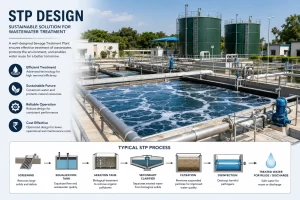
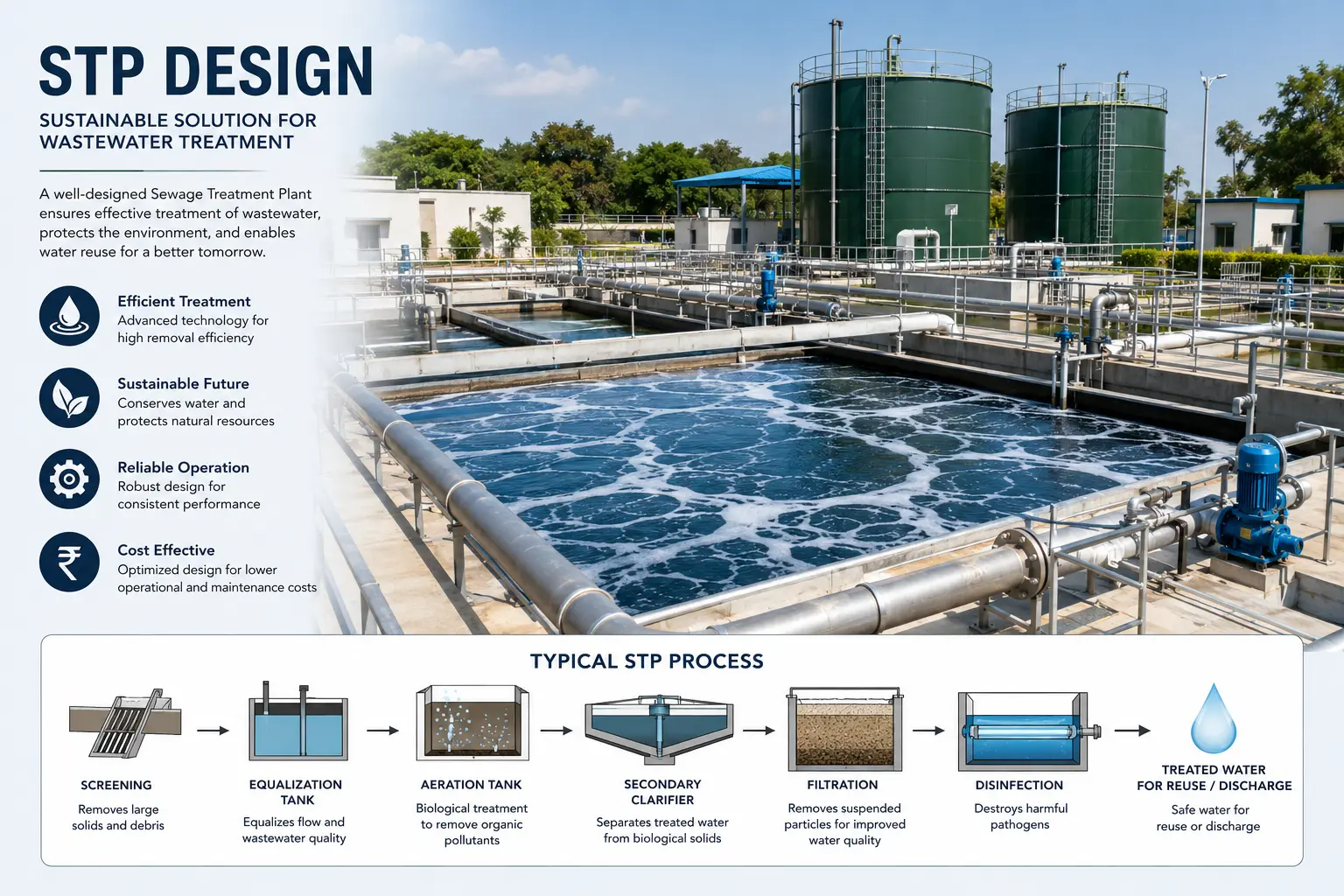
Every infrastructure project, whether residential, commercial, institutional, or industrial, generates wastewater that must be managed responsibly. As urban development accelerates and environmental regulations become more stringent, designing an efficient Sewage Treatment Plant (STP) has become an essential part of project planning rather than an optional requirement.
An STP is more than a collection of tanks, pumps, and pipelines. It is a carefully engineered system designed to treat wastewater safely before it is discharged or reused. A well-planned STP not only protects natural water resources but also reduces operating costs, supports water conservation, and helps projects comply with environmental standards. The success of any sewage treatment plant depends on its design, making professional engineering expertise a critical factor from the very beginning.
Why STP Design Matters
The performance of a sewage treatment plant is determined long before construction begins. A properly designed STP ensures that wastewater is treated efficiently under varying flow conditions while maintaining consistent treated water quality throughout its operational life.
Every project presents unique challenges. A residential township experiences different wastewater patterns than a hospital or manufacturing facility. Factors such as occupancy, water consumption, future expansion, available land, and treated water reuse requirements all influence the design approach. Simply increasing the size of equipment does not improve performance; instead, it often results in unnecessary capital investment and higher operating costs.
Understanding the STP Design Process
Designing an STP begins with understanding how much wastewater the project is expected to generate. Engineers analyse water demand, occupancy levels, peak flow conditions, and wastewater characteristics to determine the required treatment capacity.
Once the design flow is established, the most suitable treatment technology is selected based on project-specific requirements. The choice depends on factors such as available space, desired treated water quality, operational complexity, and lifecycle costs. Technologies such as Activated Sludge Process (ASP), Moving Bed Biofilm Reactor (MBBR), Sequential Batch Reactor (SBR), and Membrane Bioreactor (MBR) each offer distinct advantages and are selected based on engineering evaluation rather than preference.
The hydraulic design is then developed to ensure smooth movement of wastewater through each treatment stage without overloading any component. Proper equipment sizing, civil layouts, pipeline design, instrumentation, and automation are integrated to create a system that performs efficiently while remaining easy to operate and maintain.
Key Factors Considered During STP Design
An effective STP design is based on detailed engineering analysis rather than standard layouts. Before finalising the design, engineers evaluate several technical and operational parameters, including:
- Daily sewage generation and peak flow conditions.
- Wastewater characteristics such as BOD, COD, TSS, oil and grease, and pH.
- Available project area and future expansion requirements.
- Applicable discharge or treated water reuse standards.
- Energy efficiency, equipment accessibility, and maintenance requirements.
Selecting the Right Treatment Technology
There is no universal solution for wastewater treatment. The most suitable technology depends on the project’s objectives, operational requirements, and available budget.
For residential and commercial developments, MBBR technology is often preferred because of its compact footprint and stable biological treatment process. Projects with stringent treated water quality requirements may benefit from MBR systems, which produce high-quality effluent suitable for extensive reuse. Larger municipal or industrial developments frequently adopt ASP technology due to its proven reliability, while SBR systems provide excellent treatment efficiency where automated operation is preferred.
Rather than selecting technology based solely on current trends, experienced consultants evaluate the complete lifecycle of the facility, considering capital investment, operational costs, maintenance requirements, and future scalability.
Benefits of STP Design
A professionally engineered sewage treatment plant provides benefits that extend well beyond regulatory compliance. Proper planning during the design stage significantly improves operational performance while reducing long-term costs.
Some of the key advantages include:
- Consistent treated water quality that meets environmental standards.
- Reduced energy consumption through optimized hydraulic and process design.
- Lower maintenance requirements and improved equipment life.
- Efficient reuse of treated water for landscaping, flushing, and industrial applications.
- Flexibility to accommodate future expansion without major modifications.
Supporting Sustainable Infrastructure
Water conservation has become a priority across residential, commercial, and industrial developments. Reusing treated wastewater reduces dependence on freshwater resources while helping projects meet sustainability objectives and green building requirements.
An efficiently designed STP enables treated water to be safely reused for landscape irrigation, toilet flushing, cooling towers, road cleaning, and other non-potable applications. This not only lowers freshwater consumption but also reduces wastewater discharge into the environment, supporting responsible resource management for future generations.
Why Choose Professional STP Design Services?
Designing an STP requires expertise across multiple engineering disciplines, including process engineering, hydraulics, civil engineering, mechanical systems, electrical design, and instrumentation. Every component must function together as an integrated system to achieve reliable performance over many years of operation.
Professional consultants prepare detailed hydraulic calculations, process design reports, equipment layouts, piping networks, structural drawings, and technical specifications while ensuring compliance with applicable environmental regulations. This systematic approach minimizes operational challenges, simplifies maintenance, and provides confidence that the plant will continue performing as intended throughout its lifecycle.
A well-designed Sewage Treatment Plant is an essential investment for any modern infrastructure project. Beyond meeting statutory requirements, it plays a vital role in protecting the environment, conserving water resources, and ensuring the long-term efficiency of wastewater management systems.
By combining sound engineering principles with project-specific requirements, professional STP design delivers reliable treatment performance, lower operational costs, and sustainable water reuse opportunities. Whether developing a residential township, commercial complex, industrial facility, or institutional campus, investing in expert STP design creates lasting value for both the project and the environment.
Frequently Asked Questions
Q1. What is STP design?
STP design is the engineering process of planning and designing a sewage treatment plant that treats wastewater safely before discharge or reuse.
Q2. Which STP technology is best for a residential project?
The choice depends on factors such as project size, available space, treated water quality requirements, and operating costs. MBBR and SBR are commonly used for residential developments.
Q3. Can treated wastewater be reused?
Yes. Properly treated water can be reused for landscaping, toilet flushing, cooling towers, construction activities, and other non-potable applications, subject to local regulations.
Q4. Why is professional STP design important?
Professional design improves treatment efficiency, reduces energy consumption, lowers maintenance costs, and ensures compliance with environmental standards.
Q5. Which projects require an STP?
Residential townships, commercial buildings, hospitals, hotels, educational institutions, industrial facilities, and large infrastructure developments typically require sewage treatment plants.