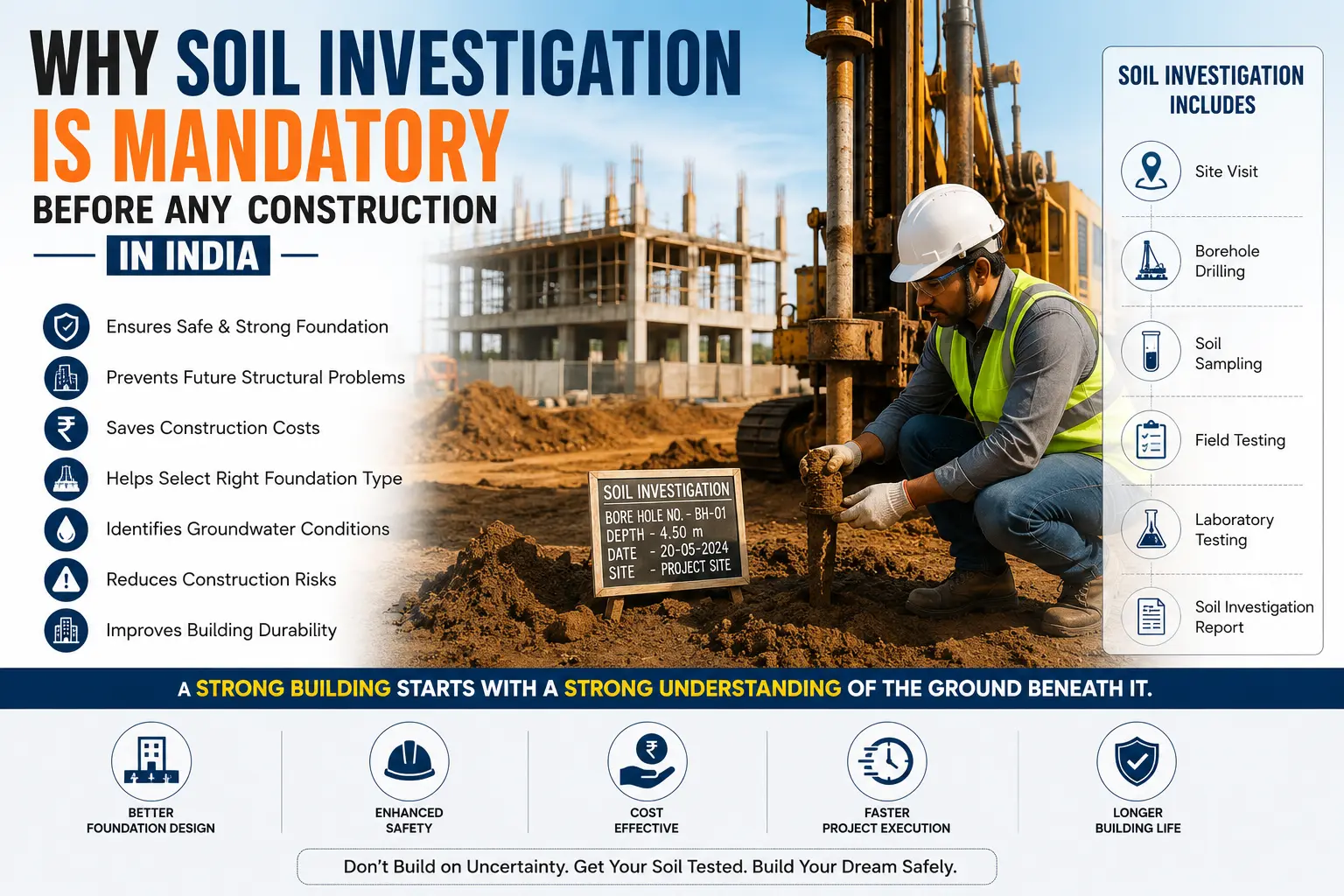
Every successful construction project starts with a strong foundation. But before designing the foundation, engineers must understand the condition of the soil. This is where soil investigation plays a crucial role. In India, soil conditions vary from one region to another. A site in Maharashtra may have completely different soil characteristics than a site in Kerala, Rajasthan, or Assam. Without proper soil testing, buildings can face settlement, cracks, water seepage, and even structural failure over time. Whether you are planning a residential home, commercial building, industrial plant, highway, bridge, or infrastructure project, conducting a soil investigation before construction is one of the most important steps.
Why Soil Investigation is Mandatory Before Construction?
- Ensures a Safe Foundation
The foundation carries the entire load of a building. If the soil cannot support this load, the structure may settle unevenly or develop cracks. A soil investigation identifies the soil’s load-bearing capacity, helping engineers design a safe and stable foundation.
- Prevents Future Structural Problems
Ignoring soil testing can lead to problems such as:
- Foundation settlement
- Wall cracks
- Floor damage
- Water seepage
- Tilting structures
- Reduced building life
- Saves Construction Costs
Many people think soil testing increases project costs. In reality, it helps reduce unnecessary expenses.
With accurate soil data, engineers can:
- Design the right foundation
- Avoid overdesign
- Reduce material wastage
- Minimize repair costs
- Prevent unexpected construction delays
- Helps Select the Right Foundation Type
Different soil conditions require different foundation systems.
Based on the investigation, engineers can choose:
- Shallow Foundation
- Isolated Footing
- Combined Footing
- Raft Foundation
- Pile Foundation
- Identifies Groundwater Conditions
Groundwater plays an important role in construction planning.
Soil investigation helps determine:
- Groundwater level
- Seasonal water table changes
- Drainage conditions
- Soil moisture content
- Supports Structural Design
Structural engineers use soil investigation reports to calculate foundation dimensions and reinforcement requirements.
- Reduces Construction Risks
Every construction project carries certain risks.
Soil investigation helps identify:
- Weak soil layers
- Loose sand
- Expansive clay
- Soft soil
- Filled-up land
- Underground voids
- Improves Building Durability
A properly designed foundation distributes loads evenly and minimizes movement.
This increases the lifespan of:
- Residential buildings
Commercial complexes
- Factories
- Bridges
- Roads
- Warehouses
- High-rise buildings
What Does a Soil Investigation Include?
A complete soil investigation generally includes the following steps:
Site Visit: Engineers inspect the location and surrounding conditions.
Borehole Drilling: Boreholes are drilled at different depths to collect soil samples.
Soil Sampling: Samples are collected for laboratory testing.
Field Testing
Engineers perform on-site tests such as:
- Standard Penetration Test (SPT)
- Plate Load Test
- Permeability Test
Laboratory Testing
The collected samples are tested for:
- Moisture content
- Density
- Grain size distribution
- Shear strength
- Plasticity
- Compaction characteristics
- Bearing capacity
Soil Investigation Report: Finally, engineers prepare a detailed report with recommendations for foundation design and construction.
Where is Soil Investigation Required?
Soil investigation is recommended for almost every construction project, including:
- Residential houses
- Apartment buildings
- Commercial buildings
- Industrial plants
- Schools and colleges
- Hospitals
- Roads and highways
- Bridges
- Railway projects
- Airports
- Dams
- Solar plants
- Wind farms
- Warehouses
- Smart city projects
Benefits of Soil Investigation
Some major advantages include:
- Better foundation design
- Improved construction quality
- Enhanced structural safety
- Lower maintenance costs
- Reduced construction risks
- Faster project execution
- Longer building life
- Better compliance with engineering standards
- Increased project reliability
Why Soil Conditions Differ Across India
India has diverse geographical conditions. Soil types vary significantly depending on the location.
Common soil types include:
- Black Cotton Soil
- Red Soil
- Sandy Soil
- Clay Soil
- Alluvial Soil
- Laterite Soil
- Gravel Soil
- Rocky Soil
When Should Soil Investigation Be Conducted?
The best time for soil investigation is before:
- Site planning
- Structural design
- Foundation design
- Excavation work
- Construction approvals
Common Mistakes to Avoid
Many project owners make these mistakes:
- Skipping soil testing to save money
- Using reports from nearby sites
- Conducting only visual inspections
- Ignoring groundwater conditions
- Choosing foundations without engineering recommendations
Frequently Asked Questions (FAQ’s)
- Why is soil investigation important before construction?
Soil investigation helps determine the soil’s strength, bearing capacity, groundwater level, and suitable foundation type, ensuring a safe and durable structure.
- Is soil testing mandatory for residential buildings in India?
While requirements can vary by project and local authority, soil testing is strongly recommended for residential construction to ensure proper foundation design and long-term safety.
- What is the purpose of a soil investigation report?
The report provides detailed information about soil properties, groundwater conditions, and foundation recommendations for engineers and architects.
- How deep is soil tested before construction?
The depth depends on the building type, foundation, and site conditions. Engineers decide the required investigation depth based on project requirements.
- What tests are performed during soil investigation?
Common tests include Standard Penetration Test (SPT), moisture content, grain size analysis, Atterberg limits, shear strength, density, compaction, and bearing capacity tests.