Digital transformation in the construction industry has led to the adoption of advanced technologies that improve accuracy and efficiency. One such technology is Scan to BIM services, which enables the creation of precise digital models from real-world structures. By integrating 3D laser scanning with BIM processes, professionals can capture existing conditions and convert them into structured, data-rich models. This approach is widely used in construction, infrastructure, and facility management projects.
What is Scan to BIM?
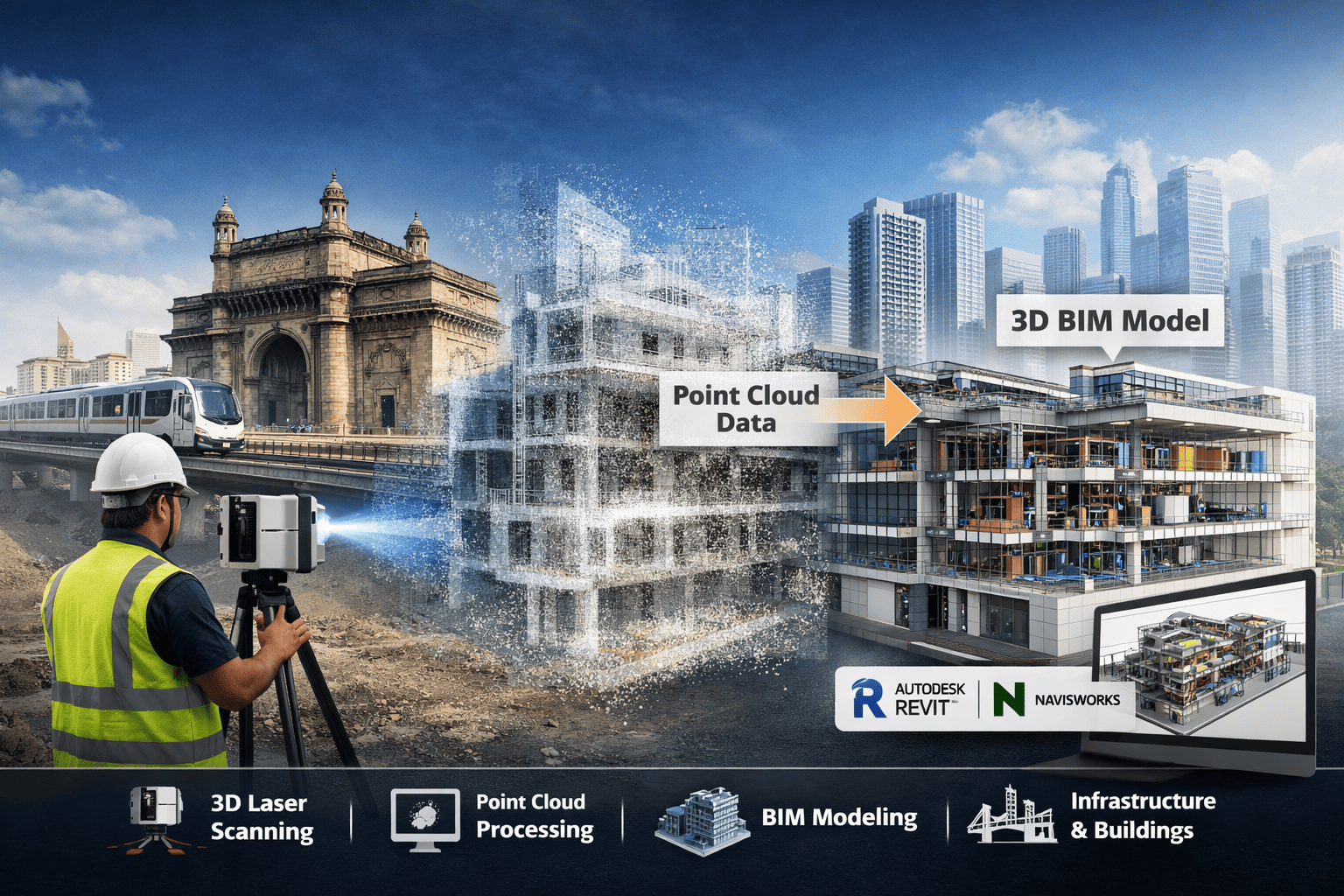
Scan to BIM (Scan-to-Building Information Modeling) is a modern approach used to create accurate digital models of existing structures. It involves capturing real-world conditions using technologies like 3D laser scanning or LiDAR, which collect detailed spatial data in the form of a point cloud. This data is then processed and converted into a structured 3D model using tools such as Autodesk Revit, helping represent the exact geometry of the site.
This process is commonly used in construction, infrastructure, and renovation projects where precise existing data is important. It allows engineers and designers to work with reliable information, improving planning and reducing the chances of errors during execution. Scan to BIM is particularly useful for older or complex structures where traditional drawings are missing or no longer accurate.
Scan to BIM Workflow
1. Data Capture: The process begins with 3D laser scanning, where scanners capture millions of spatial data points from the site. These points collectively form a point cloud dataset.
2. Data Processing: The captured scans are processed and aligned using specialized software such as Leica Cyclone. This step ensures that all scans are accurately registered into a unified coordinate system.
3. BIM Modeling: The processed point cloud is imported into BIM software like Autodesk Revit, where elements such as walls, floors, roofs, and MEP systems are modeled. This stage is often referred to as bim modeling from point cloud.
4. Validation and Coordination: The final model is checked for accuracy and completeness. Tools like Navisworks Manage are used for coordination and basic clash detection.
Technical Aspects of Scan to BIM
– Point Cloud Data
Point clouds are dense datasets that store spatial coordinates (X, Y, Z) and sometimes color information. Common file formats include:
- .RCP / .RCS
- .E57
- .LAS
– Level of Development (LOD)
BIM models are developed at different levels of detail:
- LOD 100 – Conceptual representation
- LOD 200 – Approximate geometry
- LOD 300 – Accurate geometry
- LOD 400 – Fabrication level detail
- LOD 500 – As-built conditions
– Accuracy
Scan to BIM typically achieves high accuracy, often within a few millimeters, depending on:
- Scanning equipment
- Site conditions
- Data processing quality
Benefits of Scan to BIM
- Improved Accuracy: Laser scanning captures precise measurements, reducing errors compared to manual surveying.
- Time Efficiency: Data collection and modeling can be completed faster, especially for complex structures.
- Better Visualization: 3D BIM models provide a clear understanding of existing conditions.
- Reduced Rework: Accurate models help minimize design conflicts and on-site modifications.
Applications of Scan to BIM
- Building Renovation: Used to create accurate models of existing structures before renovation.
- Infrastructure Projects: Applicable in bridges, roads, and utility systems.
- Industrial Facilities: Helps in modeling complex plant layouts and equipment.
- Facility Management: Supports maintenance and operational planning with accurate digital models.
Challenges in Scan to BIM
- Managing large datasets
- Requirement of skilled professionals
- Data interpretation complexities
- Initial investment in scanning technology
Scan to bim modeling services play an important role in modern construction workflows by enabling accurate digital representation of physical structures. From renovation projects to large-scale infrastructure, this approach improves planning, coordination, and overall project efficiency. As the adoption of BIM continues to grow, Scan to BIM is expected to become a standard practice in the industry.
FAQ’s
1. What is Scan to BIM used for?
It is used to convert real-world site data into BIM models for design, renovation, and analysis.
2. What is point cloud in BIM?
Point cloud is a collection of spatial data points captured through laser scan to bim services, used to create BIM models.
3. Which software is used in Scan to BIM?
Tools like Autodesk Revit and Navisworks are commonly used.
4. Is Scan to BIM suitable for old buildings?
Yes, it is widely used for renovation and documentation of existing structures.
5. How accurate is Scan to BIM?
It generally provides millimeter-level accuracy depending on the technology used.