Traffic consultancy helps developers, architects, and infrastructure planners design transportation systems that improve accessibility, reduce congestion, and enhance the overall user experience. By combining engineering principles with practical traffic analysis, consultants create solutions that support both present and future mobility demands.
Importance of Traffic Consultancy
As urban areas continue to expand, traffic movement becomes increasingly complex. Poorly planned entry and exit points, inefficient parking layouts, inadequate turning spaces, and conflicts between pedestrians and vehicles can lead to operational challenges and safety concerns.
Experienced traffic engineering consultants evaluate every aspect of internal and external traffic movement to ensure that developments function efficiently while meeting local authority guidelines and statutory requirements.
Parking Design Review from a Traffic Engineering Perspective
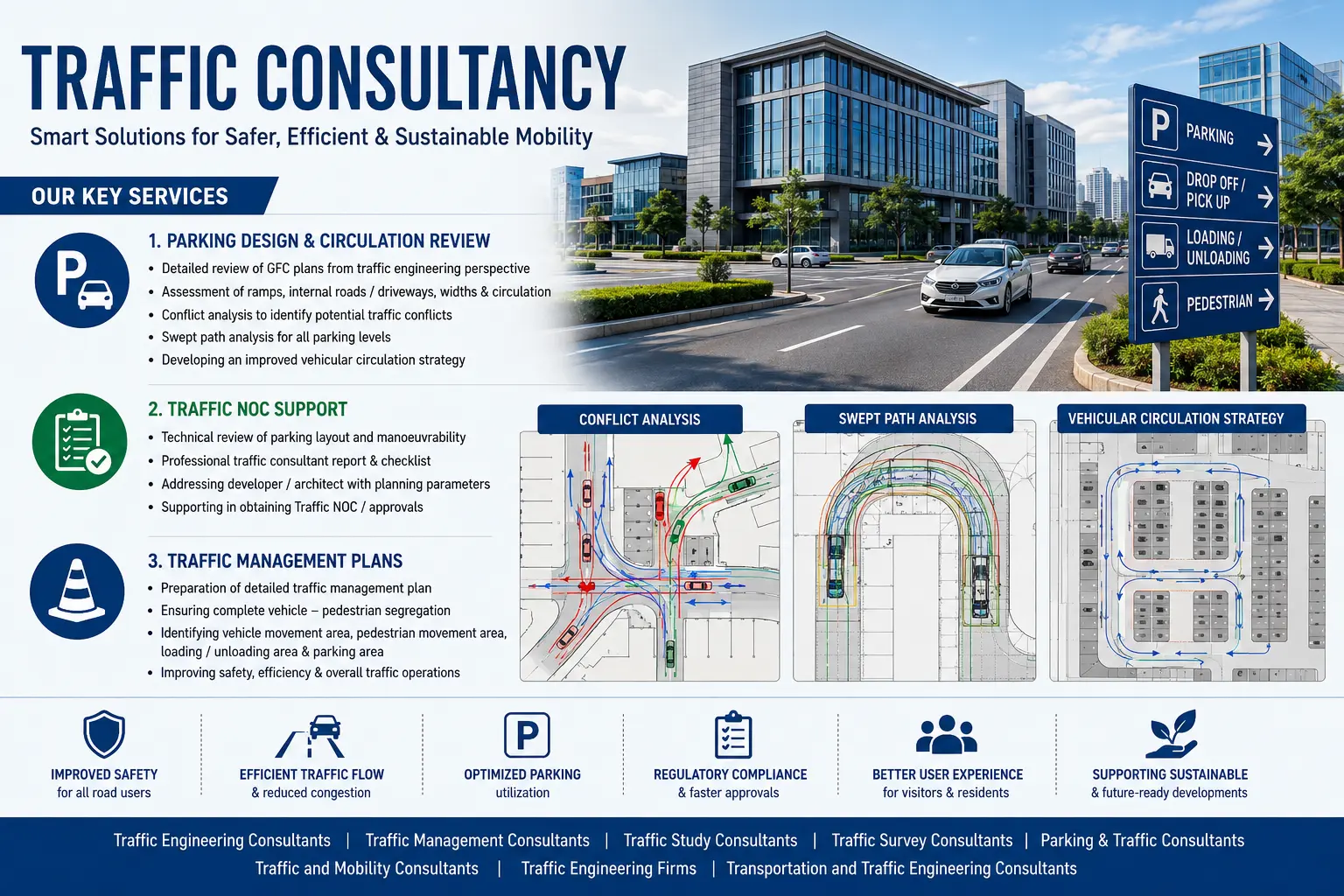
One of the most critical components of traffic consultancy is the review of parking and circulation plans during the design stage. A detailed assessment of Good for Construction (GFC) drawings helps identify design improvements before construction begins, reducing costly modifications later.
The review typically focuses on:
- Overall parking layout
- Internal circulation planning
- Driveway widths
- Vehicle access points
- Ramp geometry
- Turning movements
Consultants verify that parking layouts allow smooth vehicle movement while maximizing usability and safety. Special attention is given to ramps, ensuring that gradients, widths, visibility, and connections integrate efficiently with the overall circulation network. Proper ramp design minimizes bottlenecks and improves movement between different parking levels.
Vehicle Circulation and Conflict Analysis
An efficient circulation system allows vehicles to move safely without unnecessary delays or congestion. During the planning process, consultants study the proposed circulation pattern to identify locations where conflicts may occur between:
- Entering vehicles
- Exiting vehicles
- Pedestrians
- Loading and unloading operations
- Parking movements
Conflict analysis helps eliminate blind spots, reduce crossing movements, and improve overall operational efficiency. Where required, revised circulation strategies are developed to create smoother traffic flow throughout the project.
Another important aspect is Swept Path Analysis, which evaluates whether passenger cars, emergency vehicles, service vehicles, and delivery trucks can safely navigate internal roads, parking aisles, ramps, and turning areas without encroaching on adjacent spaces. This ensures every parking level remains functional and accessible.
Developing an Improved Vehicular Circulation Strategy
Every project has unique operational requirements. Based on traffic movement patterns and site constraints, consultants may recommend an optimized vehicular circulation strategy that improves accessibility and minimizes delays.
This may include better entry and exit configurations, revised one-way circulation systems, improved turning radii, relocation of parking access points, or dedicated service vehicle routes. The objective is to enhance traffic flow while maintaining safety for all users.
Traffic NOC Support and Technical Review
Obtaining regulatory approvals is an important milestone for any development project. Traffic consultancy services assist developers by preparing technical observations and recommendations required during the approval process.
A detailed review of parking layouts and vehicle maneuverability is carried out to ensure compliance with applicable planning guidelines. Consultants prepare professional reports highlighting traffic engineering observations, circulation efficiency, parking functionality, and architectural planning considerations.
These reports help developers, architects, and approving authorities understand the project’s traffic performance and facilitate the Traffic NOC approval process with technically sound documentation.
Traffic Management Planning
Efficient traffic movement extends beyond parking design. A comprehensive traffic management plan ensures that all users can move safely and efficiently throughout the development.
The planning process clearly defines vehicle movement corridors, pedestrian pathways, loading and unloading zones, emergency access routes, parking areas, and service vehicle operations. Proper segregation between pedestrians and vehicles significantly reduces accident risks while improving circulation efficiency.
Traffic management planning also considers signage, road markings, speed control measures, visibility at intersections, and operational procedures that contribute to safer day-to-day movement within the premises.
Benefits of Professional Traffic Consultancy
Investing in traffic consultancy during the planning stage offers several long-term advantages, including:
- Improved traffic flow and operational efficiency.
- Safer vehicle and pedestrian movement.
- Optimized parking utilization.
- Reduced traffic conflicts and congestion.
- Better emergency vehicle accessibility.
- Compliance with local development regulations.
- Faster approval process through technical documentation.
- Enhanced user experience for residents, visitors, and employees.
Role of Advanced Traffic Analysis
Modern developments often require detailed engineering analysis before implementation. Professional traffic study consultants evaluate projected traffic demand, access capacity, junction performance, and circulation efficiency to support informed planning decisions.Traffic survey consultants collect valuable field data, including:
- Traffic volume
- Turning movements
- Parking occupancy
- Travel patterns
- Pedestrian activity
These insights help create accurate traffic models and improve infrastructure planning. For projects involving large parking facilities, parking & traffic consultants ensure that parking supply, circulation, accessibility, and operational efficiency align with project requirements and anticipated vehicle demand.
Comprehensive Mobility Solutions
Today’s developments require integrated transportation planning rather than isolated traffic design. Experienced traffic management consultants work closely with planners, architects, and engineers to develop mobility strategies that improve accessibility while supporting sustainable urban growth.
Many organizations also engage traffic and mobility consultants to incorporate future-ready transportation solutions, including multimodal connectivity, pedestrian-friendly infrastructure, public transport integration, and smart mobility concepts.
Large infrastructure and urban development projects often benefit from the expertise of established traffic engineering firms, which combine technical analysis, engineering design, regulatory compliance, and operational planning into comprehensive consultancy services. For projects involving highways, commercial developments, industrial parks, airports, metro stations, and urban infrastructure, transportation and traffic engineering consultants provide end-to-end support from feasibility studies and traffic assessments to detailed design reviews, approval documentation, and implementation guidance.
Traffic consultancy plays a vital role in creating developments that are safe, functional, and future-ready. Through detailed parking design reviews, circulation planning, conflict analysis, Traffic NOC support, and comprehensive traffic management planning, professional consultants help optimize transportation infrastructure while ensuring compliance with engineering standards. By integrating practical traffic engineering principles with strategic planning, developers can improve operational efficiency, enhance safety, reduce congestion, and deliver projects that provide a better experience for every road user.