The Architecture, Engineering, and Construction (AEC) industry is undergoing a digital transformation, and Building Information Modeling (BIM) is at the center of this evolution. BIM has revolutionized the way buildings and infrastructure projects are planned, designed, constructed, and managed. Rather than relying solely on traditional 2D drawings, BIM creates intelligent 3D digital models that integrate geometry, engineering data, schedules, costs, and operational information into a single collaborative platform.
As governments, developers, and construction companies increasingly adopt digital construction practices, BIM has become an essential technology for improving project efficiency, reducing costs, minimizing errors, and enhancing collaboration among stakeholders. Along with transforming project delivery, BIM has also created exciting career opportunities for engineers, architects, designers, and project management professionals.
What is BIM?
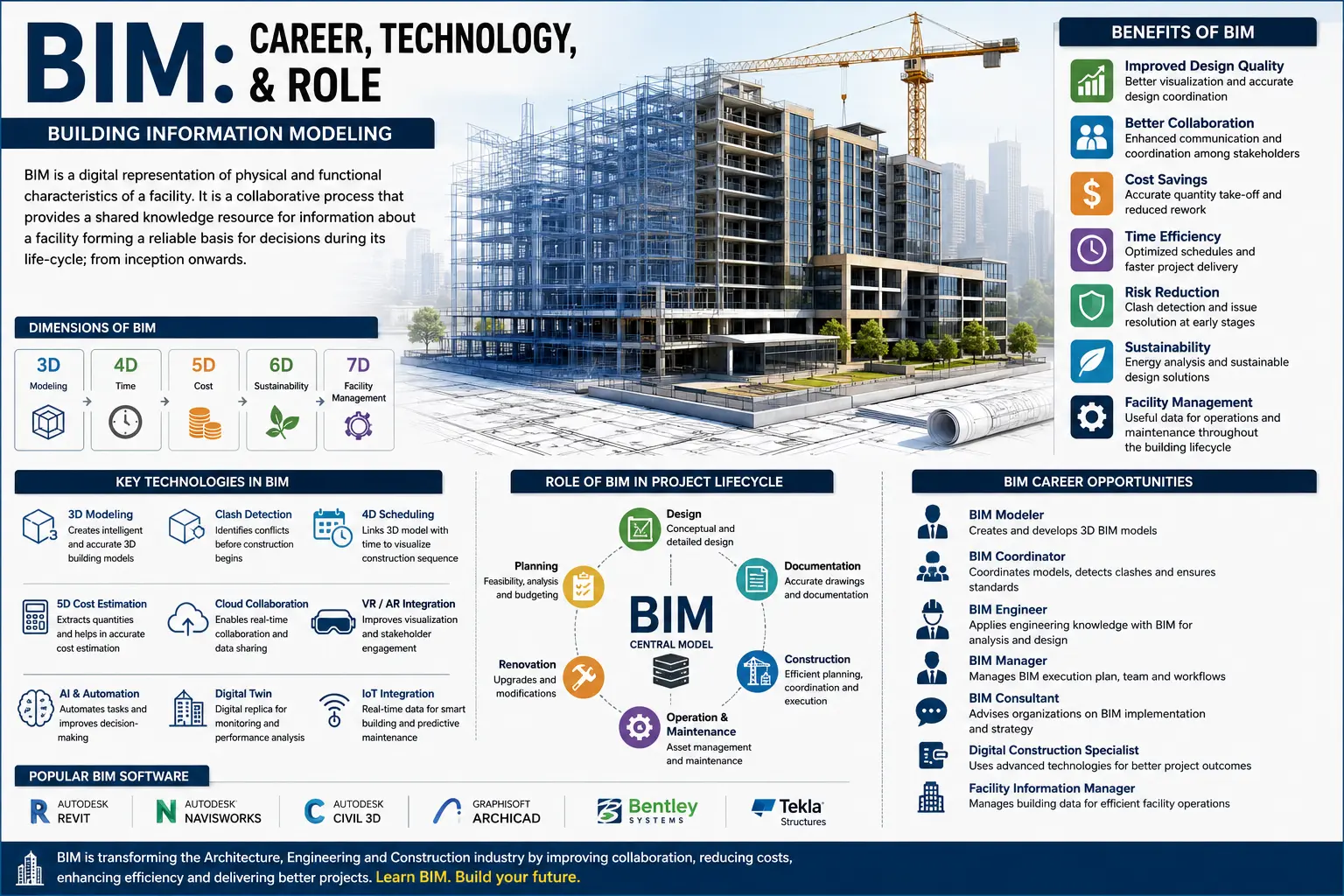
Building Information Modeling (BIM) is a process that involves creating and managing digital representations of physical and functional characteristics of buildings and infrastructure assets. BIM models contain detailed information about every component of a project, including walls, columns, beams, mechanical systems, electrical systems, plumbing networks, materials, quantities, and maintenance data.
Unlike conventional CAD drawings, BIM allows project teams to work within a shared digital environment where updates made by one discipline can be viewed and coordinated by others in real time. This collaborative approach significantly improves project accuracy and decision-making throughout the asset lifecycle.
The Evolution of BIM Technology
The construction industry has moved through several technological phases:
- Traditional Drafting: Projects were developed using manual drawings, which required significant effort and were difficult to update.
- Computer-Aided Design (CAD): CAD digitized the drafting process, improving productivity and accuracy but still focusing primarily on geometric representation.
- Building Information Modeling (BIM): BIM introduced intelligent objects and data-rich models, enabling coordination between multiple disciplines and providing valuable project insights.
- Digital Twins and Smart Infrastructure: Modern BIM technologies are now integrated with IoT sensors, cloud computing, artificial intelligence, and digital twin platforms to monitor and optimize asset performance throughout its operational life.
Key Technologies Used in BIM
- 3D Modeling: The foundation of BIM is 3D modeling, which creates realistic digital representations of buildings and infrastructure projects. These models provide better visualization and understanding of design intent.
- Clash Detection: BIM software can identify conflicts between structural, architectural, and MEP components before construction begins. This reduces costly site rework and project delays.
- 4D BIM: 4D BIM integrates project schedules with 3D models, allowing teams to visualize construction sequences and optimize project timelines.
- 5D BIM: 5D BIM incorporates cost information into project models, enabling accurate quantity take-offs, budgeting, and financial planning.
- 6D BIM: This dimension focuses on sustainability, energy analysis, and environmental performance throughout the asset lifecycle.
- 7D BIM: 7D BIM supports facility management by providing operational and maintenance information for building owners and asset managers.
- Cloud Collaboration: Cloud-based BIM platforms allow project teams from different locations to collaborate on the same model, ensuring consistency and real-time communication.
- Artificial Intelligence & Automation: AI-powered BIM tools assist with design optimization, clash resolution, risk assessment, and predictive maintenance planning.
Role of BIM in Modern Construction
- Enhanced Design Coordination: BIM enables architects, engineers, contractors, and consultants to work together within a unified digital environment. This improves coordination and reduces design conflicts.
- Improved Project Visualization: Three-dimensional models provide stakeholders with a clear understanding of project layouts, helping them make informed decisions before construction starts.
- Better Cost Control: Accurate quantity estimation and real-time project updates help organizations manage budgets more effectively and reduce unexpected expenses.
- Increased Construction Efficiency: By identifying issues during the design phase, BIM minimizes delays, improves resource allocation, and enhances overall project productivity.
- Risk Reduction: Early detection of design inconsistencies reduces project risks and improves construction safety.
- Sustainable Development: BIM supports energy analysis, material optimization, and lifecycle assessment, helping organizations achieve sustainability goals.
- Facility Management: The benefits of BIM continue after construction. Facility managers can use BIM models for maintenance planning, asset tracking, and operational efficiency.
BIM Career Opportunities
The increasing adoption of BIM across the construction industry has created a growing demand for skilled professionals.
- BIM Modeler: BIM Modelers create detailed 3D models based on architectural, structural, and MEP designs. They are responsible for ensuring model accuracy and compliance with project standards.
- BIM Coordinator: A BIM Coordinator manages model integration, clash detection, and coordination between different disciplines to ensure smooth project execution.
- BIM Engineer: BIM Engineers combine technical engineering expertise with BIM software skills to support project design, analysis, and construction planning.
- BIM Manager: A BIM Manager oversees BIM implementation, establishes workflows, develops standards, and ensures successful project delivery.
- BIM Consultant: Consultants help organizations adopt BIM technologies, improve workflows, and develop digital transformation strategies.
- Digital Construction Specialist: These professionals use BIM alongside emerging technologies such as drones, laser scanning, GIS, and digital twins to enhance project performance.
- Facility Information Manager: Facility managers use BIM data to optimize building operations, maintenance schedules, and asset management processes.
Skills Required for a BIM Career
Professionals seeking a career in BIM should develop skills in:
- Building Information Modeling workflows
- Architectural and engineering fundamentals
- Construction management principles
- 3D modeling and visualization
- Project coordination
- Quantity estimation and costing
- Data management and analysis
- Problem-solving and communication
- Collaboration and teamwork
- Digital construction technologies
Knowledge of industry-standard BIM software significantly improves career prospects and employability.
Benefits of BIM Adoption
Organizations implementing BIM experience several advantages:
- Improved project quality
- Reduced construction errors
- Faster project delivery
- Better collaboration among stakeholders
- Accurate quantity take-offs
- Enhanced cost control
- Improved sustainability outcomes
- Better asset management
- Increased client satisfaction
- Higher return on investment
These benefits make BIM an essential component of modern construction and infrastructure development.
Future of BIM
The future of BIM is closely linked with emerging technologies such as artificial intelligence, machine learning, digital twins, virtual reality, augmented reality, and smart city development. As construction projects become more complex, BIM will continue to serve as the central platform connecting design, construction, operations, and maintenance.
Governments and private organizations worldwide are increasingly mandating BIM for public infrastructure projects, further accelerating its adoption. This trend is expected to create significant career opportunities and drive innovation across the AEC industry.
Building Information Modeling has transformed the construction industry by creating a collaborative, data-driven approach to project delivery. From design and planning to construction and facility management, BIM enhances efficiency, accuracy, and sustainability throughout the asset lifecycle. As digital construction technologies continue to evolve, BIM professionals will play a crucial role in shaping the future of infrastructure development. For students, engineers, architects, and construction professionals, developing BIM expertise offers a pathway to rewarding career opportunities in one of the industry’s fastest-growing fields.