In the world’s rapidly expanding civil and construction landscape, Infrastructure Consultants play a mission-critical role in shaping sustainable, efficient, and future-ready development. Whether it is highways, metros, bridges, industrial plants, smart cities, water management systems, or urban infrastructure, professional consulting services ensure that every project is executed with technical accuracy, regulatory compliance, and long-term value creation. With rising demand for advanced engineering, environmental responsibility, and technology-driven planning, the civil industry increasingly depends on experienced consultants to transform complex ideas into commercially viable infrastructure assets.
Infrastructure consultancy is no longer limited to basic planning or engineering support. Instead, it has evolved into a full-spectrum commercial service that brings together technical expertise, digital surveying tools, project management intelligence, and cost-optimized solutions. From feasibility analysis to design, from tendering to construction supervision, and from quality monitoring to asset management, consultants deliver high-value services that help clients reduce risk, fast-track approvals, improve performance, and maximize return on investment.
What Do Infrastructure Consultants Do in the Civil Industry?
Infrastructure consultants are multidisciplinary professionals who provide end-to-end technical, managerial, financial, and regulatory guidance throughout the lifecycle of construction and development projects. Their responsibilities typically include:
1.1 Preliminary Feasibility & Concept Studies
- Site assessment and technical viability
- Market demand analysis
- Environmental impact considerations
- Preliminary cost estimation
- SWOT evaluation for commercial decision-making
1.2 Detailed Engineering & Design
- Structural, geotechnical, and architectural design
- Transportation planning
- Hydrological and drainage design
- Pavement engineering and materials planning
- Utility layout design (water, sewage, stormwater, power)
1.3 Advanced Surveying & Investigation
Civil projects rely heavily on accurate ground data. Consultants integrate modern technologies such as:
- Topographic surveys
- Drone/UAV surveys
- LIDAR scanning
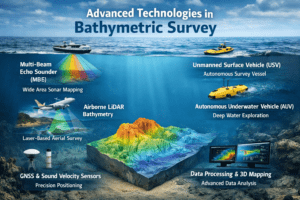
- Bathymetric surveys for water bodies
- Geophysical & geotechnical investigations
- Contour mapping and land profiling
These technologies minimize errors, speed up planning, and reduce construction risks.
1.4 Tendering, Contracts & Cost Consultancy
- Bill of Quantities (BOQ) preparation
- Technical specifications
- Vendor evaluation
- Contract documentation
- Cost monitoring and value engineering
1.5 Project Management Consulting (PMC)
- Time–cost–quality monitoring
- Construction supervision
- Risk management
- Material testing oversight
- Progress reporting and documentation
1.6 Quality Assurance & Safety Compliance
- Inspection and testing plans (ITP)
- Third-party audits
- Structural integrity checks
- Safety protocols and onsite monitoring
1.7 Digital Transformation & Smart Solutions
Modern consultants use advanced tools such as:
- Building Information Modelling (BIM)
- GIS mapping
- 3D modelling and visual simulations
- Cloud-based project dashboards
- Digital twin platforms
These technologies improve precision, reduce rework, and enable better decision-making.
Why Infrastructure Consultants Are Important for the Civil Industry
– Ensuring Technical Accuracy
Civil infrastructure requires strict compliance with:
- National Building Code (NBC)
- IRC, IS and ASTM standards
- MoRTH and CPWD guidelines
- Environmental and safety regulations
Consultants ensure that every design and construction activity meets these benchmarks.
– Reduction of Cost Overruns
Through accurate estimation, material optimization, and construction monitoring, consultants help clients:
- Avoid delays
- Prevent resource wastage
- Streamline procurement
- Increase project efficiency
– Risk Identification & Mitigation
They foresee potential issues such as:
- Unstable soil conditions
- Flood risk
- Material shortages
- Environmental restrictions
- Design conflicts
By addressing these in advance, overall project risk is minimized.
– Commercial & Strategic Advantage
Large infrastructure projects involve significant investments. Consultants provide:
- Cost-benefit analysis
- Strategic planning
- Financial modelling
- Lifecycle cost assessment
These insights help clients improve profitability and long-term asset performance.
Key Sectors Where Infrastructure Consultants
– Transportation & Urban Mobility
- Highways and expressways
- Metro rail and railways
- Flyovers, bridges, and underpasses
- Traffic impact studies
- Smart mobility solutions
– Water & Environmental Infrastructure
- Water supply networks
- Sewage treatment plants (STP)
- Effluent treatment plants (ETP)
- Stormwater drainage systems
- River training and flood mitigation
– Industrial & Commercial Infrastructure
- Industrial parks
- Warehouses and logistics hubs
- Manufacturing units
- Commercial buildings and complexes
– Energy & Utility Infrastructure
- Solar parks
- Power transmission lines
- Substations
- Oil and gas pipelines
– Smart Cities & Urban Development
- Digital mapping
- Urban planning
- Road network design
- Integrated utility management
Technology Used by Modern Infrastructure Consultants
To deliver high-value, commercially competitive services, consultants rely on advanced technologies, including:
- Total Station & DGPS
- GIS & Remote Sensing
- High-resolution Drone Mapping
- LIDAR (Airborne & Mobile)
- 3D Laser Scanning
- Ground Penetrating Radar (GPR)
- Finite Element Analysis (FEA)
- BIM Level 2 & 3 Workflows
- Enterprise Resource Planning (ERP) for construction
This digital shift ensures precision and reduces manual errors in planning and execution.
Commercial Benefits of Hiring Infrastructure Consultants
From a business perspective, consultants are not just technical partners — they act as strategic growth enablers. Key commercial advantages include:
– Faster Approvals & Compliance
- Environmental clearances
- Building permissions
- Safety certifications
- Quality audits
– Improved Profit Margins
- Optimized design
- Reduced material wastage
- Efficient contractor selection
- Controlled construction timelines
– Transparent Reporting & Documentation
- Progress dashboards
- Cost monitoring reports
- Real-time project visibility
– Higher Asset Value
Well-planned infrastructure ensures:
- Longer lifespan
- Lower maintenance cost
- Better operational efficiency
Why Businesses Prefer Professional Infrastructure Consultants
- Access to specialized experts
- Industry-specific knowledge
- Up-to-date regulatory understanding
- Strong vendor and contractor network
- Ability to manage large-scale projects
- Ensuring quality, safety, and sustainability
Whether the client is a government agency, private developer, industrial investor, or EPC contractor, infrastructure consultants provide the strategic support needed to deliver complex civil works on time and within budget.
Infrastructure consultants are essential partners in shaping the future of civil engineering and construction. Their combination of technical expertise, digital tools, commercial understanding, and regulatory knowledge ensures that projects are delivered with maximum efficiency, accuracy, and value. As the demand for modern infrastructure grows across India and globally, the role of qualified consultants will continue to expand, enabling clients to execute ambitious developments with confidence and long-term sustainability.
Infrastructure engineering consultants | Infrastructure consultancy | Infrastructure and capital projects consultant | Utility infrastructure consultants | Capital projects and infrastructure consulting | Infrastructure engineering design and consultancy services