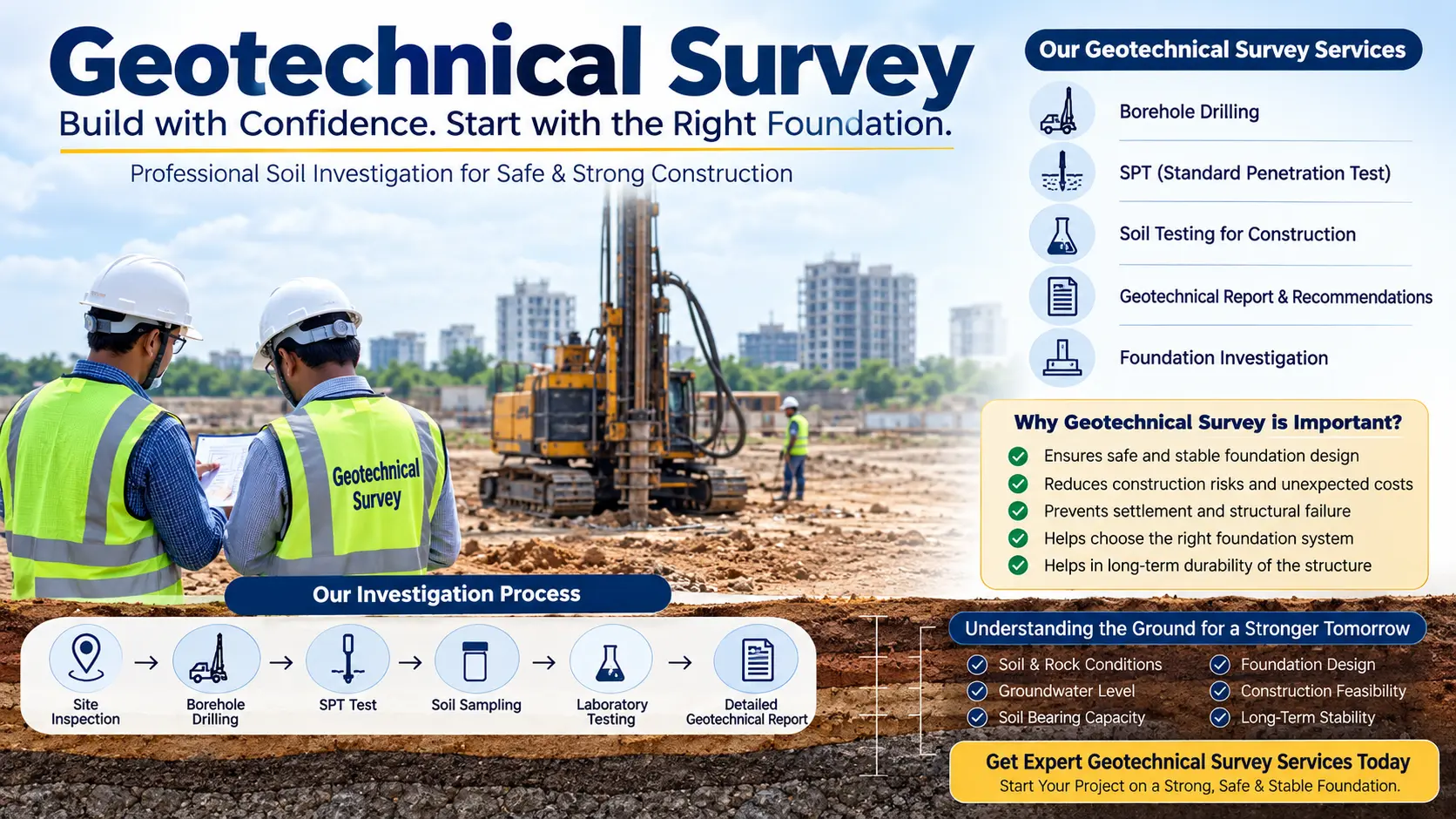
Planning a construction project? Before designing the foundation or starting excavation, understanding the ground beneath your site is one of the most important steps. A Geotechnical Survey, also known as a Soil Investigation or Geotechnical Investigation, helps determine whether the land is suitable for construction and what type of foundation will provide long-term stability.
Whether you’re developing a residential building, commercial complex, industrial facility, road, bridge, warehouse, factory, solar plant, or infrastructure project, a professional geotechnical survey reduces risk, prevents costly mistakes, and ensures your project is built on a strong foundation.
Why is Soil Investigation Important Before Construction?
Many construction issues begin below the surface. Weak soil, high groundwater, loose sand, expansive clay, or hidden fill material can lead to settlement, cracks, water seepage, and even structural failure if not identified early.
A professional soil investigation for construction helps you:
- Determine the Safe Bearing Capacity (SBC) of the soil.
- Select the right foundation type.
- Reduce construction risks and unexpected expenses.
- Improve structural safety and durability.
- Prevent costly redesigns and project delays.
- Meet engineering and regulatory requirements.
Projects That Require Geotechnical Surveys
Geotechnical investigations are recommended for almost every type of construction project, including:
- Residential buildings and villas
- Apartments and housing projects
- Commercial buildings and offices
- Industrial plants and factories
- Warehouses and logistics parks
- Roads and highways
- Bridges and flyovers
- Metro and railway projects
- Airports and ports
- Solar and wind energy projects
- Water treatment plants
- Retaining walls and basements
- Transmission line and telecom tower foundations
Services Included in a Geotechnical Survey
A complete geotechnical investigation usually includes several stages to understand the site’s ground conditions.
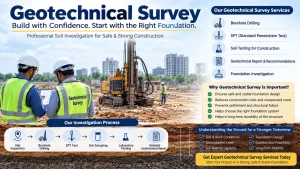
Site Inspection: Engineers visit the project location to assess the terrain, drainage, existing structures, and geological features before planning the investigation.
Borehole Drilling: Boreholes are drilled to collect soil and rock samples from different depths. This process helps identify the various soil layers beneath the ground. Many clients search specifically for borehole drilling services because this is one of the most important parts of a geotechnical investigation.
Standard Penetration Test (SPT): The Standard Penetration Test (SPT Test) measures soil resistance and helps estimate its strength and density. SPT results are widely used to calculate soil bearing capacity and foundation design parameters.
Soil Sampling: Engineers collect soil samples for laboratory testing to determine engineering properties such as strength, moisture content, density, and compressibility.
Laboratory Soil Testing
Collected samples undergo detailed laboratory testing, which may include:
- Grain Size Analysis
- Atterberg Limits
- Moisture Content Test
- Specific Gravity Test
- Compaction Test
- California Bearing Ratio (CBR) Test
- Direct Shear Test
- Triaxial Test
- Consolidation Test
- Permeability Test
- Chemical Analysis
Geotechnical Report: After completing the field and laboratory work, engineers prepare a detailed geotechnical report containing soil profiles, groundwater information, test results, engineering recommendations, and foundation suggestions.
What Does a Geotechnical Report Include?
A professional geotechnical report generally contains:
- Borehole logs
- Soil profile
- Groundwater level
- Standard Penetration Test (SPT) results
- Safe Bearing Capacity (SBC)
- Laboratory test results
- Soil classification
- Settlement analysis
- Foundation recommendations
- Construction precautions
Common Problems Identified During Soil Investigation
A geotechnical survey can reveal issues that are impossible to identify by visual inspection alone.
Some of the most common ground conditions include:
- Soft soil deposits
- Expansive black cotton soil
- Loose sandy soil
- High groundwater table
- Filled-up land
- Rock at shallow depth
- Settlement-prone areas
- Weak foundation strata
- Liquefaction risk in seismic zones
- Poor drainage conditions
A developer planned a multi-storey commercial building assuming the site had strong natural soil. However, the geotechnical investigation revealed that the upper soil layers consisted of loose fill material with low bearing capacity. Because the issue was identified before construction, the structural engineer revised the foundation design and recommended pile foundations instead of shallow footings. Although the foundation design changed, the project avoided major settlement problems, structural damage, and costly repairs after construction.
Benefits of Professional Geotechnical Survey Company
Choosing an experienced geotechnical engineering company offers several advantages:
- Accurate soil investigation reports
- Reliable foundation recommendations
- Reduced construction risks
- Better project planning
- Lower long-term maintenance costs
- Improved structural safety
- Compliance with engineering standards
- Faster decision-making for consultants and contractors
Why Choose Suncon Engineers?
Suncon Engineers provides comprehensive Geotechnical Survey, Soil Investigation, Borehole Drilling, Foundation Soil Testing, SPT Testing, and Geotechnical Engineering Consultancy services for residential, commercial, industrial, and infrastructure projects. Our experienced team uses modern drilling equipment, advanced testing methods, and industry-standard engineering practices to deliver accurate geotechnical reports that support safe, economical, and efficient construction.
Whether you need a soil test for building construction, foundation investigation, soil bearing capacity test, or a complete geotechnical investigation report, our experts can help you make informed engineering decisions.
Frequently Asked Questions
What is the purpose of a geotechnical survey?
A geotechnical survey evaluates soil, rock, and groundwater conditions to determine the most suitable foundation design and identify potential construction risks.
When should a soil investigation be carried out?
The investigation should always be completed before finalizing structural designs or beginning construction work.
How much does a geotechnical survey cost?
The cost depends on the project size, number of boreholes, site conditions, required laboratory tests, and reporting requirements.
Is a soil test mandatory before construction?
Many commercial, industrial, and government projects require a geotechnical investigation. Even where it is not mandatory, it is strongly recommended because it reduces construction risks and prevents costly foundation problems.