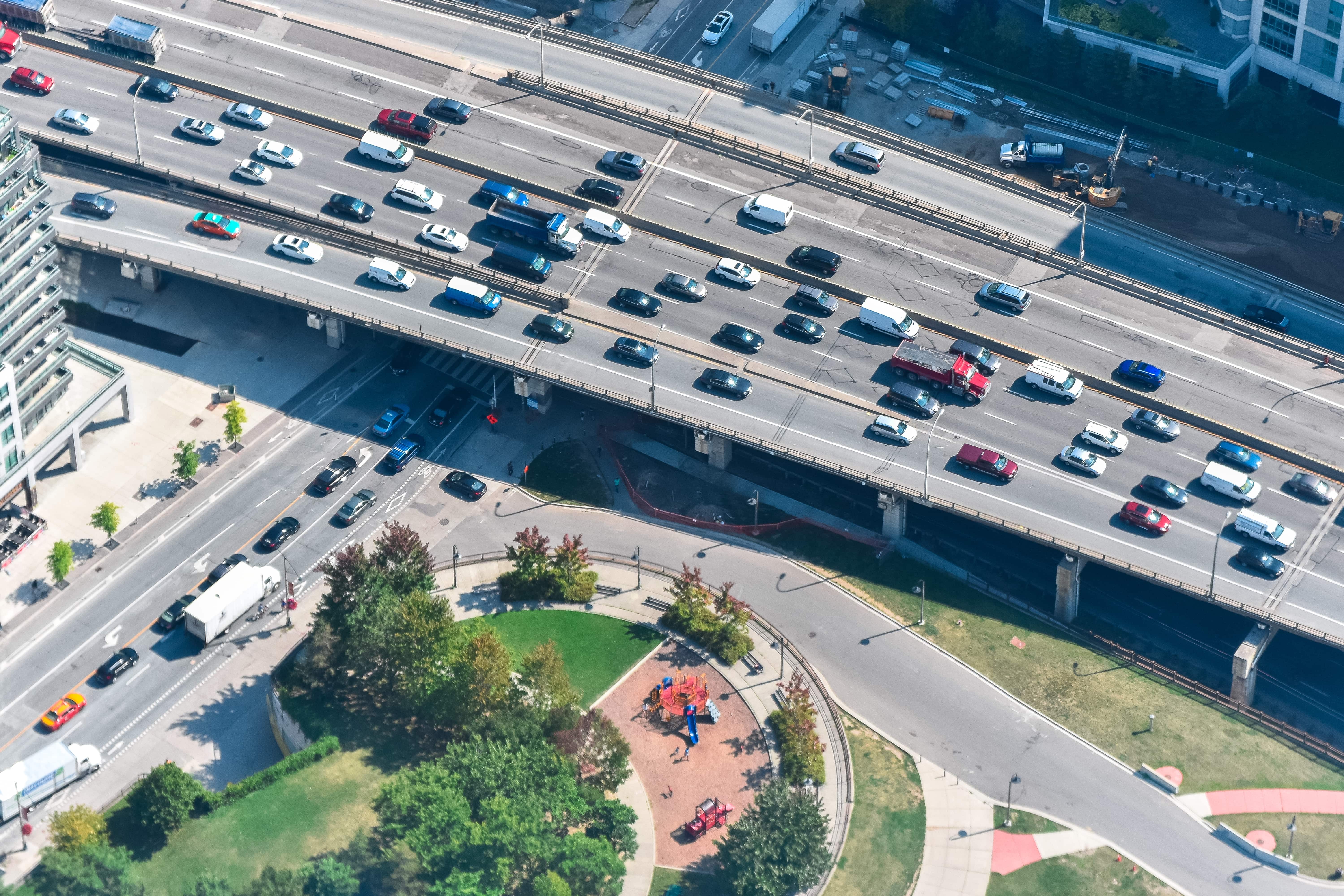
Traffic survey is a fundamental tool for urban transportation planning, road infrastructure design, and mobility management. In order to understand how different users’ cars, pedestrians, and public transportation interact with the road network, it entails the methodical collection and analysis of data. Establishing the goals of the survey is the first step in the procedure. The kind of data needed must be determined up front, whether the goal is to manage traffic, improve traffic signals, evaluate intersection performance, or make plans for future infrastructure. Traffic volume counts, turning movement counts (TMC), queue length analysis, Origin-Destination (OD) surveys, journey time analysis, classified counts, NMU (non-motorized user) counts, and more are examples of this.
Following the completion of the site reconnaissance traffic survey, each chosen location is visited to evaluate the lane markings, road geometry, intersection design, pedestrian facilities, traffic signs, and the availability of mounting points for devices such as radar sensors, ANPR cameras, or pneumatic tubes. This stage guarantees that cameras and sensors are positioned correctly and assists in choosing whether a survey is manual, video-based, or sensor-based. This is where the survey layout and safety management plan are completed, particularly for busy roads or intricate intersections.
Different traffic survey types based on standard methods and instruments:
- Traffic Volume Counts (TVC): These measure the total number of vehicles passing a point over a period (typically 15-min or hourly intervals). They can be done manually or using automated sensors like pneumatic tubes or radar.
- Classified Volume Counts: Vehicles are counted by class—two-wheelers, cars, LCVs, buses, trucks, etc to understand traffic mix. These are captured using AI-enabled video analytics or inductive loops.
- Turning Movement Counts (TMC): These are performed at intersections to measure vehicle flow in different directions: left, through, and right turns. Typically captured through overhead video cameras or drone footage.
- Queue Length Analysis: Measures the maximum, average, and clearing queue lengths during signal cycles. This helps evaluate the adequacy of current lane lengths and signal timings. Data is often extracted from time-lapse video or drone footage.
- Link / Mid-Block Counts: These monitor vehicle flow along straight sections between intersections, identifying speed consistency, platooning, and mid-link congestion.
- NMU Counts: Pedestrian and cyclist data is collected manually or via video to ensure road safety planning is inclusive of all users.
Technology-driven traffic survey is deployed:
- Origin–Destination (OD) Survey using ANPR/videos: High-resolution ANPR cameras are installed at entry and exit points to track license plates, allowing identification of travel patterns, route choices, and trip distances. The time-synchronized footage is processed using software to generate OD matrices.
- Journey Time Analysis using ANPR/Videos: ANPR also enables calculation of travel time between key links in a network. This identifies slow sections, average corridor speed, and variability in travel times during different periods.
- Axle Load Survey: Using portable Weigh-in-Motion (WIM) systems or static weighbridges, axle loads of commercial vehicles are recorded to estimate pavement wear and recommend structural reinforcement if needed.
- Public Transport Survey: These include bus headway measurements, passenger counts, and stop-level boarding/alighting analysis. The objective is to improve route efficiency and capacity utilization.
- Taxi Rank Monitoring: Surveys focus on vehicle dwell times, passenger queue lengths, and service frequency at taxi bays, helping municipalities regulate urban taxi infrastructure.
- Occupancy Survey: Used to estimate the average number of people per vehicle, especially for private cars or shared transport modes. It supports demand management and carpooling incentives.
- Level Crossing Monitoring and Reporting: Includes analysis of vehicle queues before/after train passage, wait durations, and illegal crossings during barrier closure. Helps in assessing safety risks and potential need for grade separation.
- Traffic Conflict Studies: These assess near misses and unsafe interactions between road users at intersections. High-speed video analytics and event-tagging software are used to analyze conflict types and frequency.
- Illegal Movement Detection: Employing pneumatic tubes, radar, and IR sensors, this survey detects wrong-way entries, red-light violations, or lane jumping, essential for safety audits and enforcement planning.
- Station Survey (Train/Bus): Conducted at transport terminals to evaluate passenger volume, peak load times, and waiting area adequacy. Observers or smart sensors capture the flow of users across platforms or gates.
- Market Research and Roadside Interviews: Qualitative survey such as commuter interviews, willingness-to-pay studies, and modal preference survey are conducted to understand traveler perceptions, expectations, and behavior.
All manual and automated data is compiled and processed using standard software like Excel, SPSS, or specialized traffic modeling tools. ANPR and video feeds are analyzed to extract OD data and journey times. The Saturation Flow (SAT) and Degree of Saturation (DOS) are calculated to understand the capacity utilization of intersections. SAT is the maximum vehicle throughput per lane per hour under ideal conditions, and DOS is the ratio of actual demand to that capacity. A DOS over 1.0 indicates oversaturation, pointing toward capacity deficiency.
One effective technique for spatially visualizing and superimposing various traffic datasets is GIS mapping. Urban planners can make spatially aware decisions by using geographical displays of OD paths, turning volumes, NMU heat maps, public transportation routes, and even zones of illegal movement. Plans for multimodal transportation, safety improvement techniques, and infrastructure proposals are also supported by this integration.
An essential part of post-analysis is GAP Analysis, which compares current road and transport conditions with benchmarks or required service levels. For example:
- If the queue spillback at an intersection exceeds available storage length, it indicates a lane design or signal timing issue.
- High NMU volume without zebra crossings indicates a pedestrian safety gap.
- Underutilized bus stops with long headways might suggest a service frequency gap.
The traffic survey report includes an executive summary, methodology, location-specific observations, tabular data, visual analytics (charts and graphs), GIS-based maps, and actionable recommendations. Raw data logs, picture snapshots, equipment logs, and validation results from permanent loop detectors, if included in the study, are frequently included in appendices. This report, which is frequently used in project tenders, DPRs (Detailed Project Reports), or feasibility studies, becomes a crucial deliverable for government agencies, infrastructure consultants, or urban planners.
A comprehensive traffic survey is not just about counting vehicles; it’s an integrated system of data-driven evaluations involving advanced sensors, manual observations, AI-driven video analytics, and strategic mapping. Each component, from queue length to journey time and from NMU counts to conflict studies, plays a critical role in enhancing urban mobility and designing roads that are safe, efficient, and future-ready.