Drone survey has revolutionized the field of geospatial data collection. This transformative technology has opened up new possibilities across multiple industries, from construction and agriculture to mining and infrastructure development.
Drone surveying is a smart and easy way to collect accurate data from the sky. It’s faster, safer, and more detailed than many traditional ground surveys. Land surveying, aerial photography of construction projects, and inspecting buildings, roads, and highways are all done by drones.
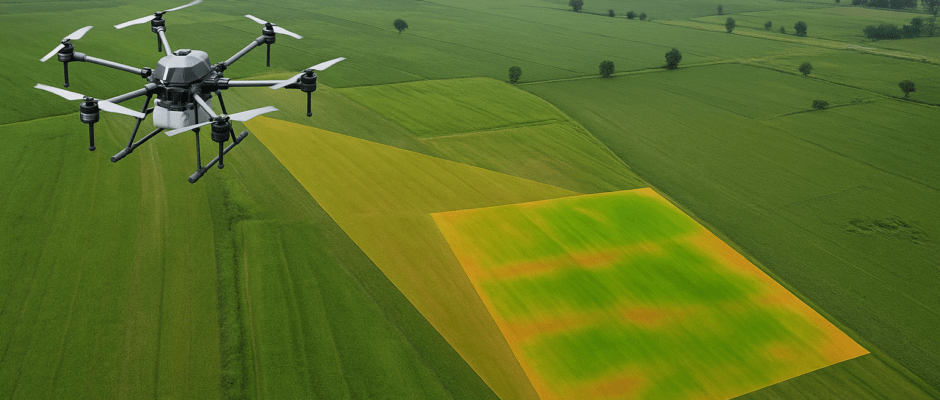
These drones carry cameras, GPS, and special sensors like LiDAR. They fly over an area and take many pictures or scan the ground. This data is processed using software to create clear 2D maps, 3D models, and height measurements.
Drone survey companies usually take care of everything planning, flying, collecting data, and giving easy-to-understand reports.
To make the data very accurate, drones use GPS with RTK or PPK systems. This gives very accurate results, just a few centimeters off, which is useful for big projects like building roads or planning land. Most commercial drones also use autonomous flight software, which ensures consistent altitude, overlap, coverage minimizing human error and increasing efficiency.
Drone surveying encompasses various methods depending on the sensor technology employed. Photogrammetry is a common method that uses many overlapping photos to make clear 2D maps and 3D models. Drone survey companies often use this method for marking land borders, planning, filling work, and designing new city areas. Photogrammetry excels in areas with clear visibility, defined features, making it ideal for surveying roads, buildings, and open fields.
LiDAR (Light Detection and Ranging), majorly used in areas with dense vegetation or uneven terrain. Photogrammetry uses normal light, but LiDAR uses fast laser beams that bounce back after hitting things. This allows for the creation of high-resolution digital elevation models even beneath tree canopies. Drone LiDAR helps in places like forests, old sites, flood areas, and power lines where normal cameras can’t see well.
In the construction industry, drone surveys are used for site visibility, grading analysis, and progress monitoring. By comparing as-built models to project plans, contractors can identify discrepancies early, avoid rework, and stay on schedule. Many construction firms now collaborate with drone mapping services to ensure regular updates, volumetric calculations of stockpiles and earthworks.
Drones have also made their mark in infrastructure inspection. Traditional inspection methods, which often involve climbing scaffolds or using cherry pickers, can be time-consuming and dangerous. Drones eliminate these risks by capturing detailed imagery from difficult-to-access locations.
Drone roof inspection companies deploy unmanned aircraft to evaluate building rooftops, checking for damage, leaks, and structural deterioration. This approach provides property managers, insurance adjusters, and facility owners with a safer and more affordable alternative to traditional inspection methods.
Key sectors where drone surveys are especially beneficial:
- Construction and Infrastructure
- Applications: Site planning, volumetric analysis, progress monitoring, 3D modeling, and quality control.
- Benefits: Speeds up pre-construction surveys, reduces on-site risks, and provides real-time updates for project management.
- Agriculture
- Applications: Crop health monitoring, irrigation planning, pest detection, and yield prediction.
- Benefits: Helps in precision farming, reduces input costs, and boosts productivity through data-driven decisions.
- Environmental and Forestry
- Applications: Vegetation analysis, deforestation tracking, erosion monitoring, and biodiversity mapping.
- Benefits: Enables large-scale ecosystem monitoring with minimal ecological disturbance.
- Urban Planning and Development
- Applications: Topographic mapping, 3D city modeling, land use analysis, and zoning.
- Benefits: Improves planning accuracy, supports smart city initiatives, and accelerates approvals.
- Real Estate and Property Management
- Applications: Site assessment, promotional aerial imagery, roof inspections, and asset audits.
- Benefits: Increases marketing appeal and reduces the cost of building inspections.
- Mining and Quarrying
- Applications: Pit mapping, stockpile measurement, blast planning, and safety monitoring.
- Benefits: Enhances productivity, reduces manual survey risks, and improves operational oversight.
- Energy and Utilities
- Applications: Inspection of solar panels, wind turbines, power lines, and pipelines.
- Benefits: Reduces downtime, lowers inspection costs, and increases safety in hazardous locations.
- Coastal and Marine Surveying
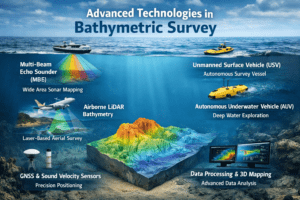
- Applications: shoreline mapping, erosion monitoring, flood risk analysis, and habitat tracking.
- Benefits: Offers efficient monitoring of dynamic coastal regions and helps in disaster preparedness.
Drone surveying has changed the way we gather, visualize, and interpret spatial data. In terms of speed, safety, and efficiency, this technology offers a number of benefits, including the precision of drone lidar services and the crisp images that drone roof inspection businesses can produce.
There is a growing need for drone survey services in major Indian cities since they grow and require infrastructure to be mapped digitally. Bengaluru, Hyderabad, Mumbai, Delhi NCR, Pune, Ahmedabad, Chennai, Coimbatore, Surat, Nagpur, Bhopal, Madurai, Kochi, Kolkata, Lucknow, and Indore are some of the cities which are seeing highest demand. These hubs utilize drone technology for smart city planning, real estate development, industrial mapping, agricultural monitoring, and environmental assessments. This makes them excellent locations for drone survey companies to do well.
Frequently Asked Question’s
6. What are the advantages of drone surveying?