Underwater survey of rivers, lakes, reservoirs, and coastal areas hide important information below the surface. This hidden world is crucial for building infrastructure, protecting the environment, and managing marine activities. Underwater survey help us explore and understand these areas. They play an important role in planning, carrying out, and maintaining projects across different industries.
What is an Underwater Survey?
An underwater survey involves the systematic inspection, mapping, and analysis of submerged areas using advanced tools and methodologies. These surveys provide accurate insights into underwater topography, structural conditions, and ecological parameters that are otherwise inaccessible.
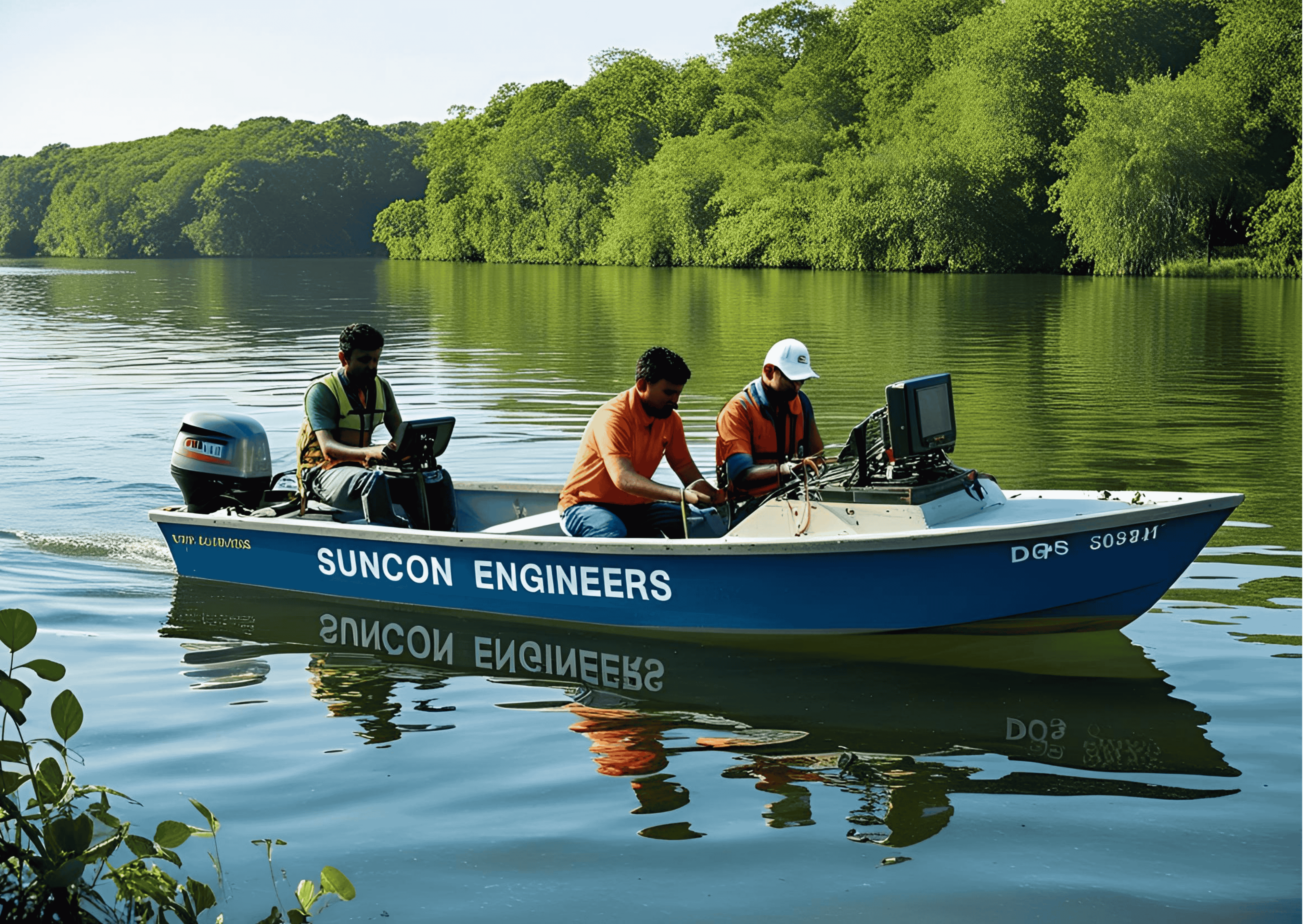
Depending on the project scope, underwater survey may use divers, remotely operated vehicles (ROVs), sonar systems, or specialized cameras to collect data. The outputs help in making informed decisions in planning, design, maintenance, and risk mitigation.
How underwater Survey is Carried Out
Underwater survey is critical in marine construction, port development, pipeline/cable routing, dredging, and environmental monitoring. These survey help map the seabed, locate submerged objects, and assess underwater structures.
- Objective Definition and Planning
- Bathymetric mapping
- Underwater infrastructure inspection
- Seabed classification
- Pipeline or cable route planning
Key steps in planning:
- Defining survey area boundaries
- Selecting appropriate equipment based on depth, water clarity, and targets
- Checking tidal and weather conditions
- Arranging necessary permissions from maritime authorities
- Selection of Survey Method
|
- Equipment Deployment
- Echo Sounders: To measure depth
- GNSS/RTK GPS: For accurate positioning
- Side Scan Sonar: To capture high-resolution images of the seabed
- Sub-bottom Profiler: To map sediment layers
- ROV/AUV: Equipped with cameras, sonar, and lights
- Diving Gear (SCUBA): For manual inspections
- Data Logging Systems: To store and analyze readings
- Data Acquisition
- Boats follow pre-defined navigation lines (survey lines or transects)
- Instruments collect depth, sonar imagery, and sediment data
- Sensors are synchronized with GPS time for precise positioning
- In ROV/AUV operations, real-time footage is captured and recorded
- Divers may use underwater slates or cameras for documentation
- Data Processing and Correction
- Tide Correction: Adjusting depths to a reference datum (e.g., Mean Sea Level)
- Sound Velocity Correction: Using CTD (Conductivity, Temperature, Depth) sensors
- Motion Correction: Accounting for pitch, roll, and heave using motion sensors
- Position Correction: Using differential GPS or RTK systems
- Data Interpretation and Reporting
- Bathymetric Maps
- Seabed Feature Maps
- Subsurface Profiles
- Volume Calculations (for dredging or reclamation)
- Inspection Reports (for cables, pipelines, structures)
- Safety Protocols and Environmental Considerations
- Dive safety protocols
- Equipment maintenance and calibration
- Noise and habitat disturbance mitigation
- Weather monitoring for offshore work
Key Services in Underwater Surveying
Underwater surveying is not a one-size-fits-all solution. Modern survey companies offer a diverse range of services tailored to specific project needs:
- Subsurface Videography and Photography
High-resolution underwater imagery is crucial for visual assessments of submerged structures, marine habitats, or sunken assets. These visuals assist engineers, biologists, and project managers in analyzing the current state of underwater environments.
- ROV (Remotely Operated Vehicle) Inspections
ROVs are deployed to inspect deep or hazardous underwater zones safely. Equipped with cameras, sensors, and lights, these robotic units collect real-time video and measurement data in challenging conditions where human divers can’t reach.
- Diver-Based Visual Inspections
For close-up evaluations or tactile assessments, professional divers perform manual survey using specialized gear and recording tools. This is often essential for infrastructure checks like dam walls, bridge piers, and intake gates.
- Underwater Mapping and Bathymetric Survey
Using sonar, GPS, and multi-beam echo sounders, bathymetric survey create detailed maps of the underwater landscape. This data is vital for port planning, dredging operations, and flood control infrastructure.
- Structural Integrity Checks
Survey often focus on identifying corrosion, cracks, biological fouling, or mechanical damage in submerged infrastructure, such as underwater pipelines, tanks, and offshore platforms.
Sectors We Serve with Underwater Survey Solutions
The applications of underwater survey are vast and cross-disciplinary. Key sectors benefiting from these services in India include:
✅ Marine Infrastructure & Ports
For wharf inspections, seabed profiling, and dredging projects, underwater survey provide essential baseline and progress data.
✅ Hydroelectric and Water Management
Dams, weirs, and intake structures require routine underwater inspections to ensure operational safety and prevent leakage or failure.
✅ Bridges and Roads
Surveying underwater bridge supports and culverts helps detect early signs of erosion, scouring, or foundational shifts.
✅ Telecom and Power Transmission
Underwater survey are essential in laying and maintaining submarine cables and pipelines, ensuring continuity of power and communication infrastructure.
✅ Oil, Gas, and Mineral Exploration
Offshore drilling operations depend heavily on seabed mapping, ROV inspections, and structural survey to monitor subsea assets and reduce operational risks.
✅ Environmental Monitoring
Government agencies and environmental consultants use underwater assessments to evaluate aquatic ecosystems, pollution levels, and biodiversity impacts.
✅ Shipping & Maritime Industries
Vessel hull inspections, propeller condition monitoring, and anchorage system checks help shipping operators avoid costly dry-docking or maritime incidents.
Technologies Used in Underwater Surveying
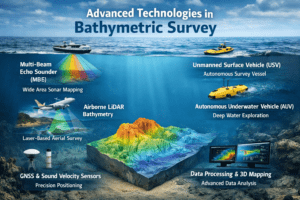
Modern underwater survey companies leverage a combination of precision tools and geospatial software, including:
- Multi-beam and Side-scan Sonars
- LIDAR and Photogrammetry
- Differential GPS (DGPS)
- 3D Laser Scanners
- Total Stations & Digital Levels
- Autonomous and Remote-Controlled Survey Drones (ROVs, AUVs)
These technologies produce high-fidelity spatial data that can be integrated into CAD, GIS, and BIM platforms for planning and asset management.
Suncon Engineers provide a wide range of underwater survey services to support infrastructure development, environmental studies, and marine operations. Our offerings include high-resolution underwater videography, ROV (Remotely Operated Vehicle) inspections, diver-based visual assessments, and bathymetric survey. Using advanced equipment and skilled professionals, we deliver accurate data and insights for projects across sectors like construction, ports, power, telecom, and environmental monitoring. Whether it’s for structural inspection, seabed mapping, or underwater asset management, our services are tailored to meet the specific needs of each project.
Our Projects:
We offer a full range of Underwater survey services, including Underwater Survey, tailored to meet the diverse needs of our clients. We are providing services in Pan India cities such as Underwater Survey Company in Mumbai | Underwater Survey Company in Pune| Underwater Survey Company in Nagpur | Underwater Survey Company in Kolhapur | Underwater Survey Company in Goa | Underwater Survey Company in Hubli | Underwater Survey Company in Bengaluru | Underwater Survey Company in Udupi | Underwater Survey Company in Hyderabad | Underwater Survey Company in Guntur | Underwater Survey Company in Kochi | Underwater Survey Company in Chennai | Underwater Survey Company in Coimbatore | Underwater Survey Company in Madurai | Underwater Survey Company in Tirunelveli | Underwater Survey Company in Ranchi | Underwater Survey Company in Indore | Underwater Survey Company in Bhopal | Underwater Survey Company in Raipur | Underwater Survey Company in Surat | Underwater Survey Company in Ahmedabad | Underwater Survey Company in Gandhinagar | Underwater Survey Company in Jodhpur | Underwater Survey Company in Jaipur | Underwater Survey Company in Kolkata | Underwater Survey Company in Bhubaneshwar | Underwater Survey Company in Lucknow | Underwater Survey Company in Delhi | Underwater Survey Company in Chandigarh | Underwater Survey Company in Guwahati supporting port development, dredging operations, and coastal monitoring. With advanced equipment and experienced professionals, we are committed to delivering high-quality survey solutions across India.