A tree/vegetation survey is a scientific way to record, study, and map the plants and trees in a certain area. It helps with environmental planning, protecting biodiversity, and sustainable development by figuring out what kinds of plants there are, how they grow, and how valuable they are to the environment. This survey makes sure that we build without destroying the green cover that makes our planet breathe, whether it’s a construction project, an industrial area, or a city redevelopment.
What is a tree or vegetation survey?
A tree or vegetation survey involves studying and documenting all plant species, their condition, size, health, and location. It provides essential ecological data used for environmental impact assessments (EIA), habitat management, and biodiversity planning.
- Identify and classify all tree/vegetation species on-site.
- Assess the health, age, and structural condition of trees.
- Determine the ecological value and conservation importance.
- Map and record tree locations using GPS or GIS.
- Recommend management actions like preservation, relocation, or replanting.
Why Do We Conduct a Tree or Vegetation Survey?
- Environmental Planning
Before any development begins, it is crucial to understand an existing ecosystem. A vegetation survey helps assess how construction or land-use change might affect local flora and fauna.
- Construction and Infrastructure Projects
Government authorities often require a tree survey report as part of project approval or clearance. It ensures that development plans avoid harming ecologically valuable trees or habitats.
- Biodiversity Conservation
These surveys identify rare, threatened, or protected plant species, enabling conservationists to create plans for their protection or transplantation.
- Legal and Regulatory Compliance
Many environmental laws mandate tree assessments before land development, road expansion, or industrial activity. A certified tree or vegetation survey ensures compliance with these laws.
- Climate and Green Cover Monitoring
Vegetation surveys also help monitor the health of green cover, contributing to climate resilience studies and carbon sequestration monitoring.
Importance of Tree or Vegetation Surveys
Tree/vegetation surveys are not just about plants; they’re about protecting the balance of life. Here’s why they are so important:
- Protecting Ecosystems and Biodiversity
By identifying key species and habitats, surveys prevent the destruction of ecologically sensitive zones and maintain biodiversity balance.
- Supporting Sustainable Urban Development
In growing cities, maintaining green spaces is vital. Surveys help urban planners design cities that integrate trees and natural landscapes rather than replace them.
- Informed Decision-Making
Accurate vegetation data enables planners, architects, and engineers to make environmentally responsible decisions backed by science.
- Guiding Reforestation and Restoration
Survey results are used to plan afforestation or replantation programs, ensuring that lost green cover is restored strategically.
- Balancing Human and Ecological Needs
Development and conservation don’t have to conflict. These surveys help achieve a balance where both can thrive.
Benefits of Conducting a Tree or Vegetation Survey
- Environmental Benefits
- Preserves biodiversity and natural habitats.
- Reduces deforestation and soil erosion.
- Helps mitigate the urban heat island effect.
- Contributes to carbon capture and improved air quality.
- Regulatory and Project Benefits
- Fulfils legal and environmental clearance requirements.
- Prevents project delays caused by non-compliance.
- Provides baseline ecological data for environmental reports.
- Planning and Design Benefits
- Assists landscape architects in integrating green infrastructure.
- Supports eco-friendly urban planning and smart city design.
- Guides developers on tree preservation and transplant options.
- Social and Community Benefits
- Promotes a healthier, greener living environment.
- Encourages public awareness and participation in conservation.
- Enhances the visual and aesthetic value of urban areas.
- Long-Term Sustainability
- Enables periodic monitoring of vegetation health.
- Provides data for climate change adaptation and mitigation projects.
- Supports long-term sustainability goals and CSR initiatives.
Modern Tools and Technologies in Vegetation Surveys
- GIS Mapping Systems – for spatial analysis and mapping tree density.
- Drones and Remote Sensing – for aerial vegetation mapping.
- GPS Devices – for precise tree location tagging.
- Tree Health Sensors – to assess moisture, disease, or stress levels.
- Environmental Data Software – for ecological data visualization.
How to Conduct Tree/Vegetation Survey
- Preliminary Study and Site Review
Before starting fieldwork, surveyors conduct a desktop study to gather basic information about the site. This includes reviewing maps, satellite images, soil data, and previous ecological reports. It helps understand the topography, land use, and vegetation type before entering the field.
- Field Observation and Ground Survey
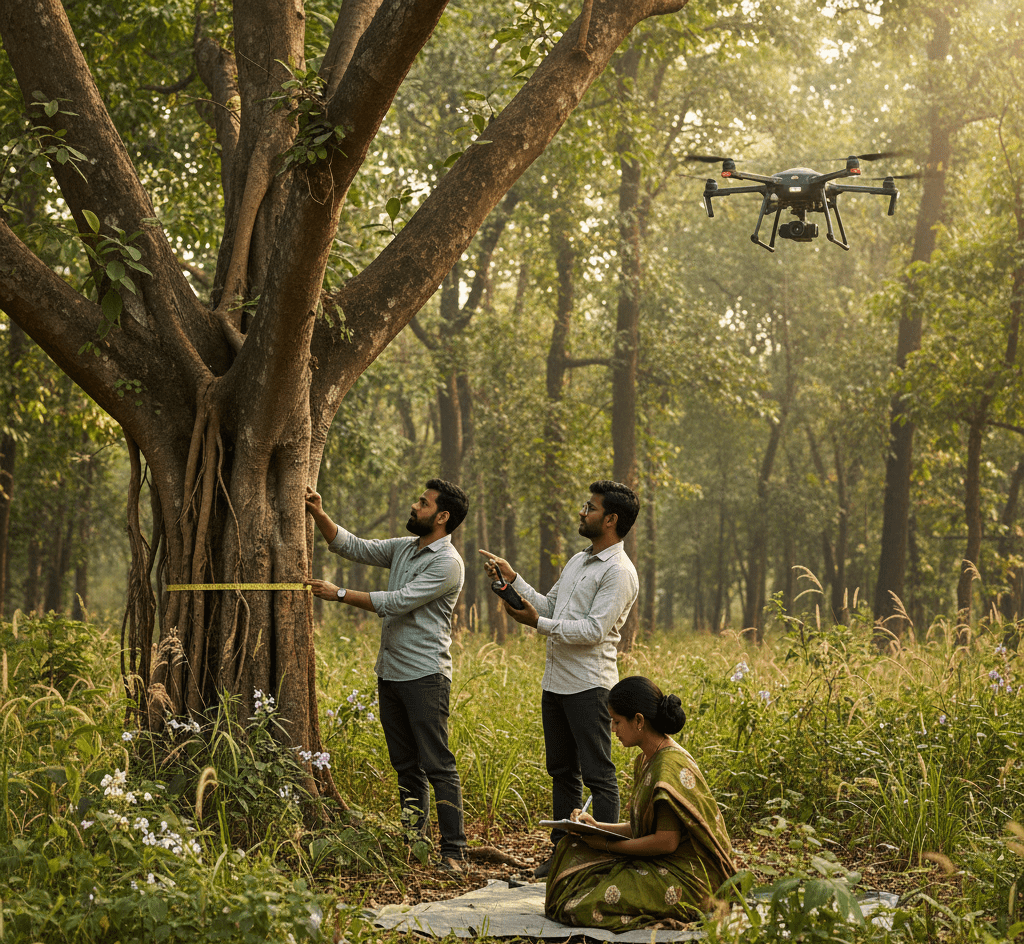
Once the planning is complete, experts visit the site for a ground-level survey. They observe, identify, and record all trees, shrubs, herbs, and grasses present within the area. Measurements such as tree height, trunk diameter, canopy spread, and health condition are taken using standard forestry tools.
- Sampling Methods
- Quadrat Method: Dividing the site into small plots (usually 5x5m or 10x10m) and recording vegetation inside each plot.
- Transect Method: Drawing straight lines (transects) across the area and noting plant species along these lines.
- Random Sampling: Selecting random points to ensure unbiased data.
- Tree Identification and Data Recording
Each tree or plant species is identified by its botanical and local name.
- Species name
- Girth or diameter at breast height (DBH)
- Tree height
- Canopy size
- Health and vitality
- GPS location
- Mapping and GIS Integration
Collected data is processed and converted into vegetation maps using Geographical Information Systems (GIS). This provides a visual representation of the vegetation distribution and density across the site. In many modern surveys, drone mapping and satellite imagery are also used for better accuracy.
Frequently Asked Questions (FAQs) on Tree or Vegetation Survey?
- What is a tree or vegetation survey?
A tree or vegetation survey is a scientific assessment that records and analyses the types, conditions, and distribution of trees and plants within a specific area. It helps in understanding the ecological value of a site and is often used in environmental impact assessments (EIA) and land development planning.
- Why is a tree/vegetation survey important?
This survey is crucial for protecting biodiversity, ensuring sustainable development, and maintaining ecological balance. It helps planners and developers identify valuable trees, protect green spaces, and comply with environmental regulations.
- When is a tree survey required?
A tree survey is usually required before starting any construction, infrastructure, or land development project. It ensures that existing trees are properly documented and that decisions regarding removal or transplantation are made responsibly.
- Who conducts a tree or vegetation survey?
These surveys are typically conducted by qualified ecologists, arborists, or environmental consultants who specialize in vegetation mapping, tree health assessment, and ecological impact studies.
- What information does a tree survey report include?
- Tree species (scientific and common names)
- Tree height and canopy spread
- Health and structural condition
- Location mapping (GPS or GIS)
- Recommendations for retention, transplantation, or removal