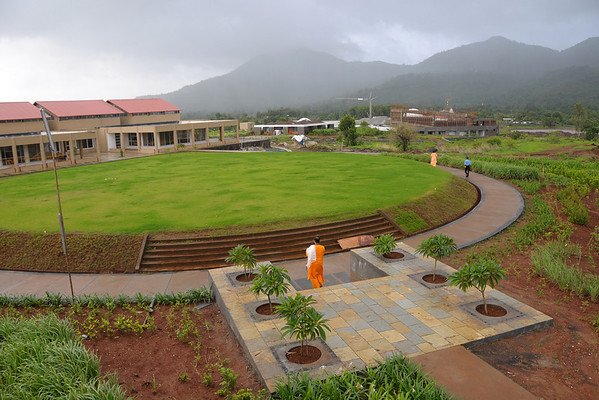
This Site is situated between Mumbai and Pune near Kolwan village. It is an expression of gratitude concretized in the form of a centre that spans of 65 acres of serene, pictorial landscape surrounded by Sahyadri mountains.
Climate Conditions:
The area where site is situated has been surrounded by Sahyadri hills. The mean yearly temperature recorded in Kolwan is 23.2°C. Kolwan also receives heavy rainfall, in a year. The annual average rainfall is 2084 mm.
Site Observations:
The length of Main road is 1720.00 Meter having carriage width from 6 to 8 Meter.
There is steep Elevation along the alignment of road. The RL Near entrance gate is 604.50 M and near Ganesh Temple it is 661.20. The difference is about 56 Meters within the plot area of Chinmaya Mission. The overall slope is from North side to South side.
It is known that the construction of Road is done in the year 2011-12.
It is seen that the WBM Road is constructed and grouting treatment is given.
In some of the area pot-hole fillings are done.
It is generally observed that the proper camber and super elevation is not done.
The storm water drainage system is also found to be inadequate
PRELIMINARY SURVEY & INVESTIGATION
The Engineering survey has been carried out to ascertains the exact nature of road from the Entry to e Ganesh temple.
- Topographical Surveys: The basic objective of the topographic survey was to collect the Existing essential ground features of Nalla, roads, existing CD work details etc. The data collected will result in the final design of flexible pavement.
-
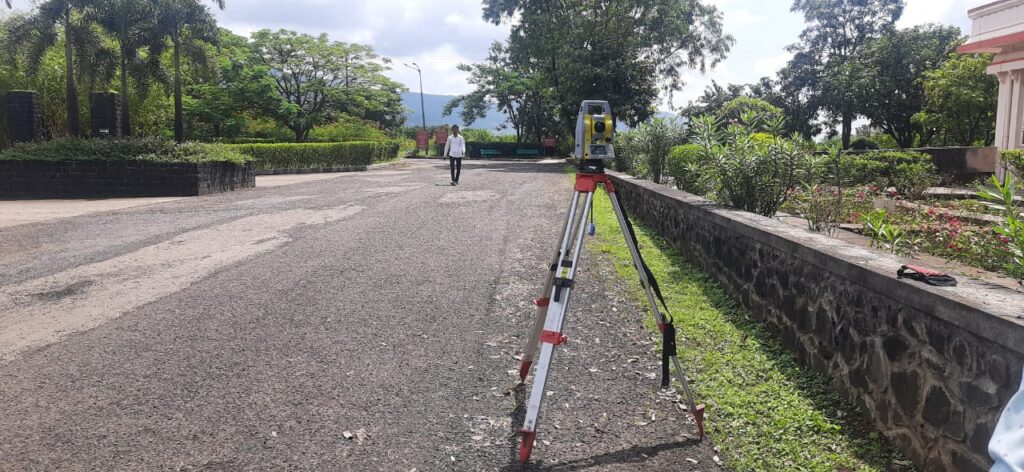
Detailed Survey of Topographical Features: Topographical survey using total station has been carried out to collect sufficient data to prepare the map of the physical features of the area. The levels are taken with the help of DGPS System.
-
Following existing features have been captured during the survey: Existing road, canal crossing, Footpath, Trees, Street Light Poles, Storm water drains, Water supply lines, etc. Existing Structures.
-
Topographical survey was carried out using Total Station of 1 sec. accuracy for detailed mapping and traversing. As part of the survey, the following activities were carried out. Cross Sections: Cross sections have been taken for a minimum width of 15 m from the centreline of the Existing alignment through longitudinal section point on either side of road. Cross section levels were taken at every 1 to 2 m. Longitudinal Section: Longitudinal Section levels along the centerline were taken at 10 m. interval. Near curves and important features this interval was suitably reduced. Cross sections point for the required width was taken corresponding to each point in the longitudinal section. Map Plotting: The existing features surveyed were directly feed into Computer Aided Software and the details of the same have been plotted.
-
-
- SOIL INVESTIGATION & PAVEMENT CONDITIONS: For evaluating the strengthening requirement of existing flexible pavement, trial pits are taken. Performance of flexible pavement is closely related to Elastic deflection of pavement under the wheel loads. The deformation or elastic deflection under a given load is depends upon the subgrade soil type, moisture content and compaction, the thickness and quality of pavement course etc. Hence the Benkelbeam Deflection test is also carried out.
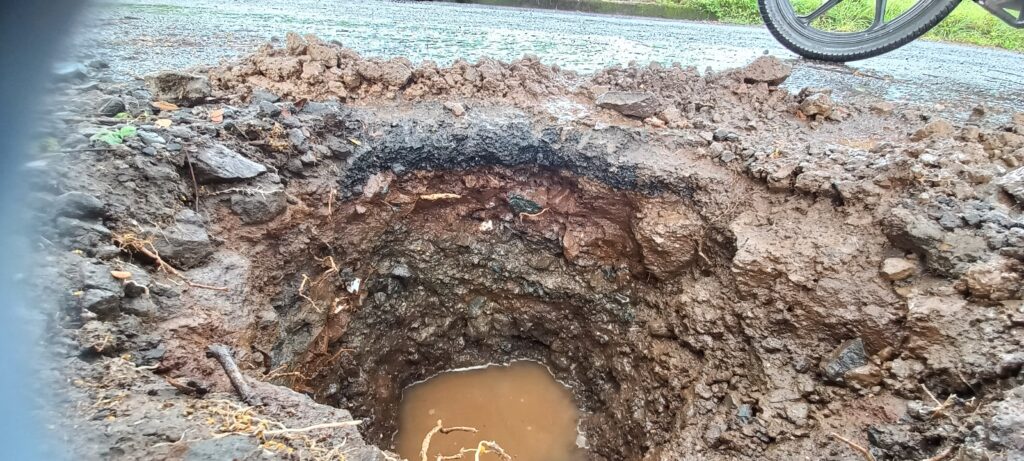
- Trial pits: Trial pits have been taken to know the pavement layer details of existing road. The 6 trial pits have been taken at various locations along the alignment of road.
- Benkelman Beam Test: For strengthening of flexible road pavement Benkelbeam deflection test is conducted on 21.09.2023 as per IRC 81:1997. The test has been conducted at 100m interval on either side in staggered manner.
- PAVEMENT DESIGN: The design procedure is carried out as per relevant IRC/ IS codes. In present case we have studied two options for pavement such as Flexible Pavement and Rigid Pavement. The design details are given below. We also design the section of storm water drains and same is also incorporated in this chapter.
- Flexible Pavement: The overlay thickness is worked out based on the results received as per the Benkelman Beam Test.