OBJECTIVE & SCOPE OF INVESTIGATION
The objective was to characterize the subsurface conditions in the area of planned construction & to provide soil bearing capacity recommendations. The scope of work is drilling and sampling in eight boreholes and carrying out relevant laboratory tests on representative soil and rock samples.
1 FIELD EXPLORATIONS
1.1 Sub Soil Profile
2. LABORATORY TESTING
3. GROUND WATER
4. CONCLUSION AND RECOMMENDATION
4.1 Geotechnical consideration
4.2 Foundations
4.3 Excavation & Earthwork
4.4 Limitation of the report
4.5 Bearing Capacity Calculations
FIELD EXPLORATIONS
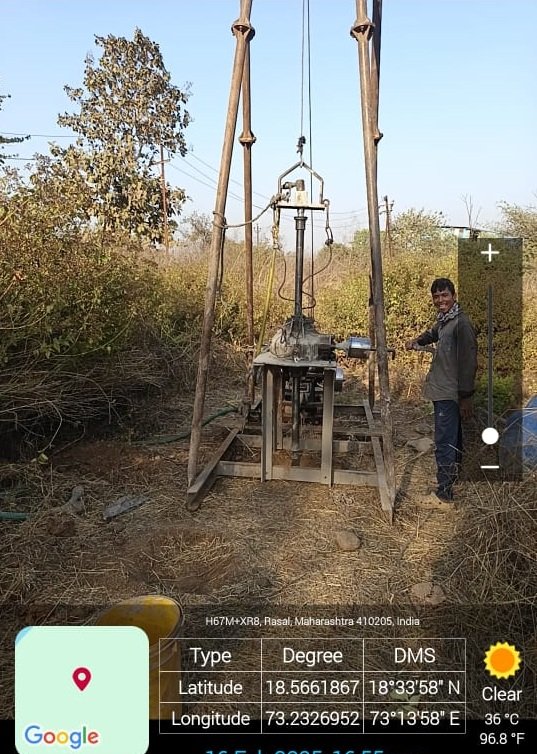
The field exploration was conducted during Feb 2025. Eight boreholes were drilled on the location shown by the client. The boring details are shown in bore logs. Drilling and sampling in rock was carried out using a rotary drilling rig. Borehole is advanced with an NX-sized double-tube core barrel with a diamond bit used to drill in rock. Water was circulated to cool the drilling bit. The groundwater table was recorded after 24 hours of completion of drilling. Changes in the character of the soil are determined partly by the feel of the driller or the resistance to penetration and rotation of the bit and partly by examination of the spoils in the water as it emerges from the casing, but definite identification of the soil can only be made when representative samples are taken from the borehole.
SUB SOIL PROFILE:
Subsoil conditions described below are based on drilling and sampling in eight boreholes. A generalized subsoil profile for the area investigated is furnished in the bore logs attached.
▪ Layer I: Brownish Black Colored Silty Soil/Gravelly Soil
▪ Layer II: Reddish moderately to slightly Weathered fractured Compact basalt/compact basalt rock/compact basalt with white Infilling
LABORATORY TESTING:
Samples were collected from the site & sent to the laboratory for conducting required tests. Laboratory tests were carried out as per client, consultant’s requirement in accordance with procedures described in the relevant Indian standard codes. The following tests were conducted per the relevant IS code.
CONCLUSIONS & RECOMMENDATIONS:
Geotechnical consideration:
Based upon the subsurface conditions encountered at the test location, engineering analysis of the stratum was performed to determine the net safe bearing capacity. Parameters obtained are based on various field and laboratory tests. The safe bearing pressure of soil has been evaluated as per IS 6403-1982, IS-8009 part I – 1993 based on “N” value. Silty Soil is present up to 2.5m depth; below, completely to highly weathered & fractured basalt is encountered up to 3.0m. followed by compact basalt rock up to 10m depth i.e termination depth. Proposed construction, as informed, is a retaining wall & industrial shed. Loads are expected to be high. Based on stratification encountered, an open foundation is suggested
Foundation Recommendation
It is recommended to adopt allowable safe bearing capacity for pad foundations placed at a depth from the existing ground surface at the time of investigation.
Excavation & Earthwork
- For a foundation placed on rock, the excavated surface shall be compacted for at least 90% of the Proctor test value. After compaction, PCC shall be laid.
- For foundations placed on rock, prior to placement of blinding concrete, cracks or loose pockets shall be filled by PCC. It is suggested to rest the foundation on same strata for one structure & place it in dry surface conditions. Excavation sides should be sloped at a maximum slope of 2:1 (horizontal: vertical) or flatter within 1.5m of the original ground surface.
- Good quality backfill (non-expansive soil) material shall be filled around the footing with proper compaction.
- Final grades should allow proper drainage away from the structures so that water does not accumulate around the foundation & floor slab.
• Vegetation, debris, trash, fill material should be stripped and hauled off site or used landscape area.