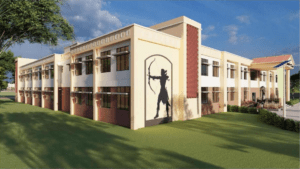
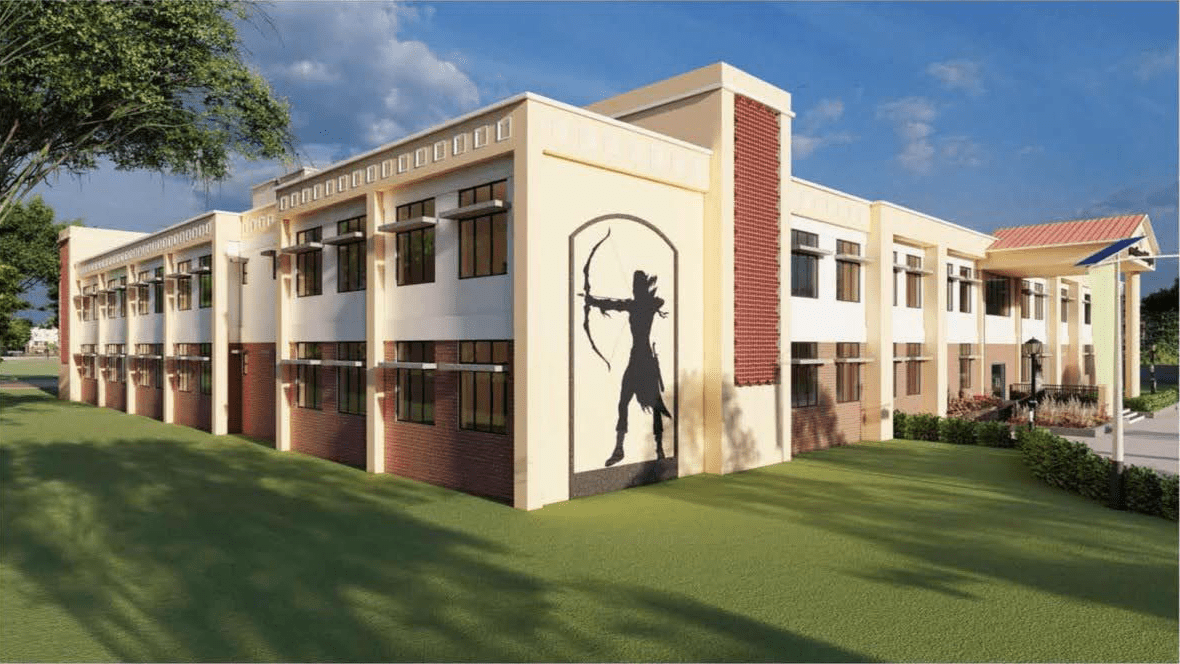
Construction of Eklavya Model Residential Schools (EMRS) at Sonua, village Lota, District- West Singhbhum district, Jharkhand Phase-II comprises of 0.5 unit of Boys hostel (for 120 students), 0.5 unit of Girls hostel (for 120 students), 15 nos. Type-III quarters for teaching staff with 01 no. guest house at GF, 10 nos. Type-II quarters for non-teaching staff, 01 Type-V quarter for Principal including water supply & sanitary installations, electrical installation, drainage, sports, remaining part of development of site and bulk services (Civil, electrical, furniture and Kitchen machinery).
Project Overview
The Eklavya Model Residential School is one of the flagship program of Govt. of India to impart quality education to the tribal students in the remotest tribal block in the India. Under the scheme, the tribal block with more than 50% ST population and at least 20,000 tribal population, will have an Eklavya Model Residential School (EMRS). EMRS will be at par with Jawahar Navodaya Vidyalaya and will have special facilities for preserving local art and culture, besides providing training in sports and skill development. Across the country, there are 452 blocks/taluka/tehsil were identified to get the benefit of this scheme.
Ministry of Tribal Affair (MoTA) accorded construction work of 23 No’s of EMRS to National Project Construction Corporation Limited at different blocks/district in the State of Jharkhand. The construction work in respect of 21 Nos. of EMRS (Phase-I) have already been commenced and work is in progress.
Now this DPR for EMRS Sonua (Phase-II) has been prepared which includes the remaining construction of comprises of 0.5 unit of Boys hostel (for 120 students), 0.5 unit of Girls hostel (for 120 students), 15 nos. Type-III quarters for teaching staff with 01 no. guest house at GF, 10 nos. Type-II quarters for non-teaching staff, 01 Type-V quarter for Principal including water supply & sanitary installations, electrical installation, drainage, sports, remaining part of development of site and bulk services (Civil, electrical, Furniture and Kitchen machinery) as per approved EMRS Standard including PMC Charges etc. for PSUs.
MODEL GENERATION
The building is planned as a combination of R.C.C. columns and beams of framed structure. After preliminary sizing of Various structural members a computer model of the structural frame of Building are generated for carrying out computer aided analysis to check the effects of vertical and lateral loads that are likely to be imposed on the structure. The building structure are analyzed using ETABS software. ETABS has been thoroughly tested validated and internationally recognized software & apprised by several organization and is well suited for the analysis of any structure system. Geometrical dimensions member properties and member connectivity including eccentricities are modeled in the analysis . Variation in material grades if present are also considered. The permissible values of the load factors and stresses are utilized Within the purview of the Indian standards. The computer aided analysis are valuated individual internal forces reactions at foundation level and deflection pattern of the entire structure and in the individual members. The data are used to verify adequacy of the member sizes adopted and after further iteration to arrive at the most appropriate design of the structural members. Some re-runs of the analysis programs are required for arriving at the optimum structural space frame Characteristics that satisfy the strength and stability criteria in all respects. The hoIe structure are idealized as a space frame. Beams and columns in the structure. The shear walls and floor slabs arc modeled as membrane elements. The structure is analyzed for all possible loads i.e. gravity loads, live loads and earthquake/wind loads acting on it throughout its lìfe span.
CONTROL OF DEFLECTION
In order to control deflection of structural elements, the criteria given in clause 23.2 of IS: 456:2000 is proposed to be used.
CONTROL OF CRACKING
In order to avoid excessive cracking in the flexural members. maximum diameter and spacing of the reinforcements is restricted as per the detailing rules indicated in clause 26.0 IS: 456:2000.
WATER RETAINING STRUCTURE (IF ANY)
There shall be designed as per IS: 456 – 2000 and Indian Code IS: 3370 – latest version. Live load surcharge shall be accounted for all designs wherever applicable.
MASONARY WALL
Masonry walls have been treated as non structural Infill panels. Therefore, the structural safety of these walls is ensured by treating them as one was / two was slab panels spanning between adjoining beams and columns. These walls are designed as unreinforced masonry as per IS: 1905-1987 and IS: 4326-1993. For purpose of loading of masonry loading. it has been considered brick masonry with density of 1800 kg per cu.m and 12 to 15mm thickness plaster on each face.
SEISMIC ANALYSIS & DESIGN
3-D analysis has been carried out using ETABS software for seismic load evaluation both static approach as well as dynamic approach using Response Spectrum are used. For seismic analysis slab at each floor will be treated as rigid diaphragms. So that all frames sway equally at floor levels under application of lateral load. Response Spectrum method with masses lumped at joints with 5% damping and seismic coefficient as applicable under zone III as per IS: 1893- 2016 shall be adopted. All response of structural moments and forces will be adjusted accordingly as per
clause 7.8.2 of IS: 1893. For the combination of forces under seismic load 50% live load shall be adopted as per clause 7.3.2 of IS 1893, all responses of the structure moments and forces shall be adjusted accordingly. As the building foot print is not regular, approximate static analysis is not sufficient to provide right results, as in the proposed analysis scaling of the seismic forces is being done thus dynamic analysis will provide realistic estimate of design forces.