Urbanization is transforming cities across the world bringing better infrastructure, housing, and economic growth. But with this growth comes one of the most persistent urban challenges i.e parking.
As cities expand, the number of vehicles grows exponentially, leading to severe parking shortages, traffic congestion, and environmental concerns. According to the United Nations, nearly 68% of the global population will live in urban areas by 2050, making parking management an even more critical part of sustainable city development. Effective parking solutions are now not just a matter of convenience they are a necessity for urban mobility, livability, and economic productivity.
Urban Parking Problem
In most cities, the number of vehicles far exceeds the available parking spaces. Studies show that:
- Around 30% of urban traffic is caused by drivers searching for parking.
- On average, a driver spends 10–15 minutes daily looking for parking space.
- In dense city centres, parking can occupy up to 40% of total land area.
This imbalance between parking demand and space availability leads to:
- Traffic congestion and air pollution
- Illegal roadside parking
- Reduced pedestrian and cyclist safety
- Lower efficiency in commercial areas
Therefore, cities are turning toward innovative, space-saving, and technology-driven parking solutions.
Types of Parking Solutions for Urban Areas
- Smart Parking Systems
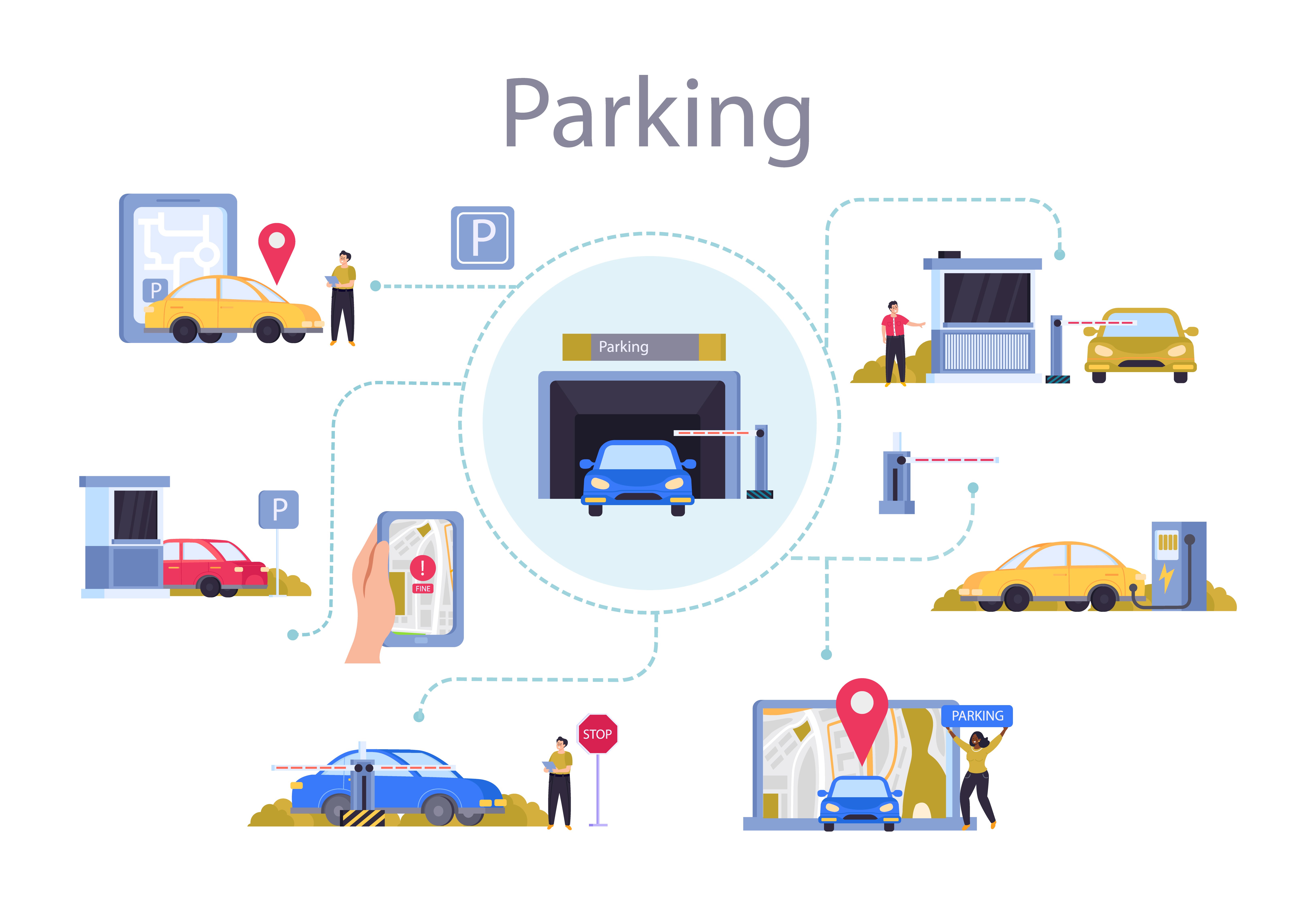
Smart parking uses Internet of Things (IoT) sensors, mobile apps, and cloud platforms to detect and manage parking space availability.
Drivers can find, reserve, and pay for spots in real-time through digital platforms.
Key Features:
- Real-time data on available parking
- Cashless, ticketless entry and exit
- Traffic reduction through faster parking
- Data analytics for future planning
- Multilevel Parking Facilities
As ground space becomes scarce, vertical or multilevel parking systems are increasingly used. These can be fully or semi-automated and are ideal for urban commercial and residential zones.
Benefits:
- Accommodates 3–10 times more vehicles than surface lots
- Uses less land area
- Provides better security and safety
- Minimizes visual clutter on roadsides
- Underground Parking
Underground parking structures help preserve the surface area for green spaces, pedestrians, or recreational zones while offering large vehicle capacity.
Advantages:
- Saves ground-level space
- Improves aesthetics and urban landscape
- Offers weather protection and security
Many mixed-use developments and metro stations across Europe and Asia integrate multi-level underground parking to support high commuter volumes.
- Shared and Mixed-Use Parking
Shared parking is an efficient way to use the same parking spaces for different users at different times for example, office workers during the day and residents at night.
Advantages:
- Reduces overall parking infrastructure costs
- Supports mixed-use developments
- Encourages cooperation between businesses and residents
- Sustainable and Green Parking
Sustainability in parking is becoming a core part of urban planning. Modern facilities incorporate eco-friendly materials, renewable energy, and water management systems.
Key Features:
- Permeable pavements to reduce stormwater runoff
- Solar-powered lighting for energy savings
- EV charging stations for electric vehicles
- Green roofs and vertical gardens to improve air quality
- Park-and-Ride Facilities
Park-and-ride systems combine private vehicle parking with public transport access. People park their vehicles on the city outskirts and take metros or buses to central areas.
Benefits:
- Reduces congestion in downtown zones
- Promotes public transport use
- Saves fuel and time for commuters
Role of Technology in Modern Parking
Technology is transforming how parking is planned, managed, and used in cities. Some major innovations include:
- Automated parking guidance using digital boards and sensors.
- License Plate Recognition (LPR) for entry and exit automation.
- Mobile-based payment apps and QR systems.
- AI-based predictive analytics for estimating demand at different times.
- Cloud-based management dashboards for city administrators.
Urban Planning and Policy Support
Parking solutions are not just about technology they also depend on strong urban policies. Effective governance includes:
- Dynamic pricing (charging more in high-demand areas)
- Reduced parking minimums for new developments
- Incentives for EV and bicycle parking
- Integration with smart city infrastructure
- Regulation of street and off-street parking zones
A city with proper parking policy reduces unnecessary construction costs, improves traffic flow, and enhances public transport usage.
Economic and Environmental Impact
Efficient parking management brings multiple long-term benefits:
- Saves land and construction costs for developers
- Boosts business access and retail sales through better parking availability
- Cuts fuel waste and emissions caused by vehicles searching for parking
- Promotes eco-friendly mobility and urban sustainability
The Future of Parking in Cities
Future urban parking will evolve around three key principles: automation, integration, and sustainability.
Emerging trends include:
- Fully automated robotic parking garages
- EV-only and autonomous vehicle-compatible parking
- Smart parking integrated with AI traffic control
- Subscription-based or on-demand parking services
As electric and self-driving vehicles become more common, parking infrastructure will adapt to serve these advanced mobility systems.
Parking is more than a convenience it is a critical component of urban infrastructure that influences mobility, environment, and city life quality.
Modern cities must move away from outdated parking practices and adopt smart, sustainable, and technology-driven systems that optimize space, save energy, and improve efficiency.
With proper planning, innovation, and public-private collaboration, cities can create parking systems that truly support a cleaner, smarter, and more liveable urban future.
FAQ’s
- What causes parking problems in cities?
Rapid urbanization, population growth, and increasing vehicle ownership outpace available parking spaces, creating congestion and inefficiency. - How can smart parking systems help?
They provide real-time data on space availability, reduce search time, and improve overall traffic flow. - What are the benefits of multilevel parking?
Multilevel parking saves land, accommodates more vehicles, and helps keep streets clear and organized. - Why is sustainable parking important?
It reduces pollution, saves energy, and supports electric vehicle infrastructure, contributing to greener cities. - 5. What is the future of parking solutions?
Automation, AI-based management, and integration with EV and autonomous vehicle systems will define the future of urban parking.