The mining industry is undergoing a technological transformation, and at the center of this change is the Mining Drone Survey. Traditionally, mining survey were time-consuming, dangerous, and expensive. However, with the rise of drone technology in mining, companies can now perform high-resolution aerial mapping, monitor stockpiles, and track site changes with speed and precision.
What is a Mining Drone Survey?
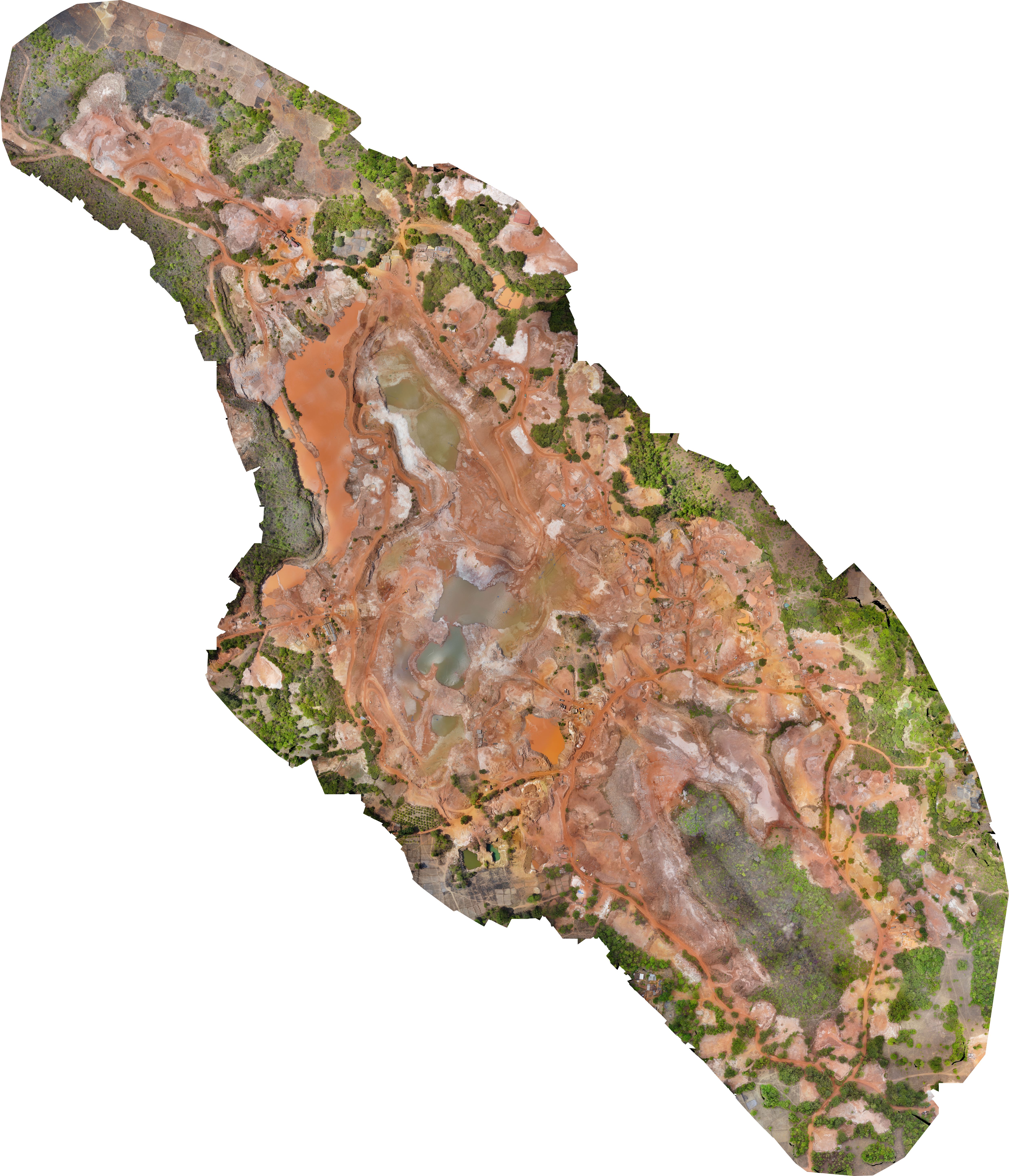
A mining drone survey is the use of unmanned aerial vehicles (UAVs) equipped with cameras, LiDAR, or multispectral sensors to map, monitor, and measure various elements of a mining site. These drones capture detailed aerial data, which is processed to create orthomosaic maps, 3D models, and digital elevation models (DEMs).
How Does Drone Survey Work in Mining?
Drone surveys in mining are conducted using unmanned aerial vehicles (UAVs) equipped with advanced sensors such as Ground control point (GCP Points), LiDAR scanners, RGB cameras, and multispectral imaging systems. The process begins with flight planning software like Pix4Dcapture or Drone Deploy, where surveyors define the flight planning, altitude, and area coverage by using KML file. Once the drone such as the DJI Phantom 4 RTK, sense Fly eBee X, or DJI Matrice 300 RTK takes off, it autonomously captures high-resolution images or LiDAR data across the mining site. The data is then processed using photogrammetry tools like Pix4Dmapper, Agisoft Metashape, or Propeller Aero to produce accurate orthomosaic maps, digital elevation models (DEMs), and 3D terrain models. These outputs are analyzed for volumetric calculations, pit design, slope stability, and stockpile measurements. Drone surveying dramatically reduces time and manpower requirements while enhancing accuracy and operational safety in mining environments.
Key Applications of Drone Survey in Mining
- Mine Planning and Exploration
Drones provide accurate terrain data for planning pit design and infrastructure layout. - Volume and Stockpile Measurement
With drone survey software, operators can measure stockpile volumes accurately without physical contact. - Slope Monitoring and Geotechnical Inspection
Drones with thermal and visual sensors help monitor slope stability and identify potential landslide zones. - Blasting and Drilling Assessment
Pre-blast and post-blast drone survey help optimize drilling patterns and evaluate blast results. - Environmental Monitoring
Drones help monitor dust, erosion, vegetation, and water bodies around the mine, ensuring regulatory compliance. - Mine Safety Inspection
Drones can inspect high walls, confined areas, and inaccessible zones reducing risk to human life.
Benefits of Mining Drone survey
- Increased Accuracy: Drone survey can achieve up to 2 cm/pixel ground resolution more accurate than most manual survey.
- Cost-Effective: Reducing the need for manual labour and equipment, drones lower operational survey costs significantly.
- Time-Saving: Survey that once took days or weeks can now be completed in a few hours.
- Safer Operations: Drones reduce the need for humans in hazardous zones, improving safety across the site.
- Real-Time Monitoring: Mining companies can conduct frequent, even daily, survey for up-to-date insights.
Drone Types and Sensors Used in Mining
- Fixed-Wing Drones: Ideal for covering large mining areas and exploration zones.
- Multi-Rotor Drones: Better suited for small sites or vertical inspections like pit walls.
- LiDAR-Enabled Drones: Best for dense vegetation or when elevation accuracy is crucial.
- RGB and Multispectral Cameras: Used for surface modelling, vegetation health, and terrain inspection.
Drone Survey Software for Mining
- Pix4Dmapper
- Drone Deploy
- Propeller Aero
- Agisoft Meta shape
- Trimble Stratus
These tools offer volumetric calculations, cut/fill analysis, progress tracking, and export options to GIS or CAD platforms.
Regulatory and Safety Considerations
- In India, DGCA permission and NPNT-compliant drones are mandatory.
- Operators must maintain VLOS (Visual Line of Sight).
- Safety procedures must be in place for flight planning and risk assessment.
Challenges in Mining Drone Survey
- Data Overload: Processing high volumes of data requires robust systems.
- Weather Dependency: Rain and wind can impact flight operations.
- Battery Limitations: Flight duration is limited, especially in large areas.
- Skill Requirement: Requires trained UAV pilots and GIS specialists.
Future of Drone Survey in Mining
As automation and AI continue to grow, the integration of real-time drone data with digital twin models, AI-based image analysis, and IoT sensors will revolutionize how mining sites are managed. The future of mining drone survey lies in:
- Real-time hazard alerts
- AI-driven terrain classification
- Autonomous drone swarms for 24/7 monitoring
Mining drone survey are revolutionizing how mines are mapped, monitored, and managed. With improvements in drone hardware, photogrammetry software, and compliance procedures, mining companies can now access high-resolution, real-time, and cost-effective data with minimal risk. As drone adoption accelerates across India and the globe, integrating this technology is not just an option it’s a necessity for modern mining operations.
Our Projects:
Mining Drone Survey at Kasarde
➢ Verify and correctness of existing DGPS mapped GCP’s and Lease Boundary Coordinates.
➢ High Resolution Orthomosaic image of Lease area including 100m Buffer zone and
also stockpiles area mapping which is outside the lease area.
➢ Digital Elevation Model DEM/DTM/DSM.
➢ AutoCAD DWG files with all the Vector data with contour details / mapping showing existing mining area and stockpiles in the surrounding area.
➢ All other data as per IBM requirement.
➢ All the captured data to be given in soft and hard form.