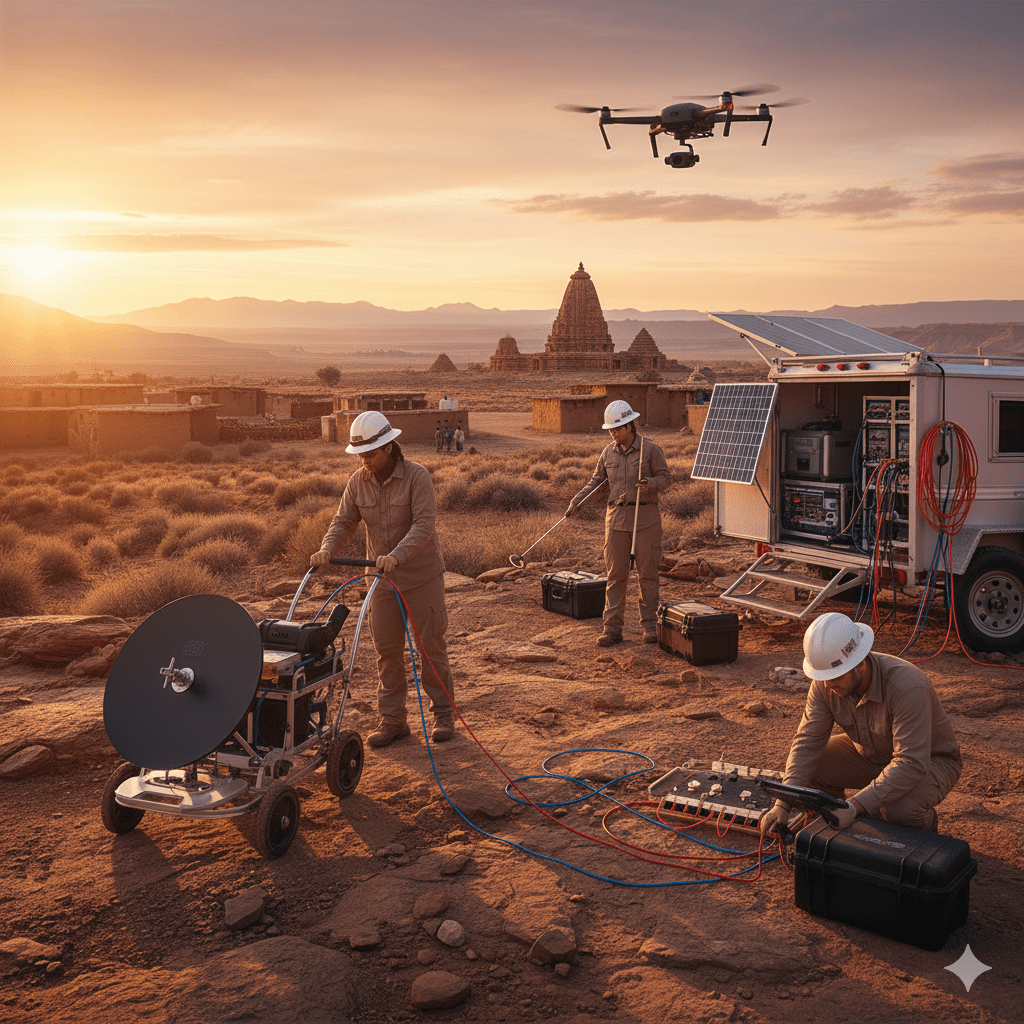
Geophysical Survey is one of the most advanced and non-destructive techniques used to study the physical characteristics of the Earth’s subsurface. It helps engineers, scientists, and planners gather data without extensive drilling or excavation. This survey is particularly valuable in soil exploration, geotechnical investigation, mineral exploration, groundwater mapping, and civil construction projects.
What is a Geophysical Survey?
A Geophysical Survey involves the measurement of various physical properties such as seismic velocity, electrical resistivity, magnetic susceptibility, gravitational field, and electromagnetic response. These measurements help in mapping subsurface layers, locating groundwater, identifying faults, and determining soil strength and rock type.
Engineers and geoscientists use geophysical methods to interpret hidden soil and rock characteristics, providing a detailed understanding of underground conditions without disturbing the surface.
Importance of Geophysical Surveys in Soil Exploration
Civil and geotechnical engineering, soil exploration is the foundation of design and construction. The stability of any structure be it a building, bridge, dam, or highway depends on the nature of the soil and rock beneath it. Traditional boring or test pit methods, while accurate, are expensive and time-consuming.
Geophysical surveys offer several advantages:
- Non-invasive: No need for drilling or excavation.
- Cost-effective: Covers large areas quickly.
- Time-saving: Faster data acquisition and interpretation.
- High accuracy: Detects variations in soil properties and hidden anomalies.
- Environmental safety: Causes minimal disturbance to the natural environment.
Geophysical Methods of Soil Exploration
Different geophysical methods are selected based on the project requirements, soil type, and investigation depth. The major techniques used in soil exploration include:
- Seismic Refraction Method
The seismic refraction method measures the travel time of seismic waves generated by an impact source (like a hammer blow or explosion) as they pass through different soil or rock layers.
Application:
- Determining depth of bedrock
- Identifying soil layers and groundwater table
- Estimating elastic properties of the subsurface
Advantages:
- High accuracy for stratified formations
- Useful for large-scale projects like highways, dams, and tunnels
- Electrical Resistivity Method
This method measures the electrical resistance of the ground to the flow of electric current. Different materials (clay, sand, rock, or water) have distinct resistivity values, helping identify subsurface variations.
Application:
- Groundwater exploration
- Soil contamination studies
- Foundation assessment and site investigations
Techniques Used:
- Vertical Electrical Sounding (VES) – determines resistivity variation with depth.
- Resistivity Imaging (2D/3D) – gives a cross-sectional view of the subsurface.
- Ground Penetrating Radar (GPR)
GPR uses high-frequency electromagnetic waves to detect buried objects and stratigraphic boundaries. Reflections occur when waves encounter materials with contrasting dielectric properties.
Application:
- Mapping shallow soil layers
- Locating buried utilities, pipes, and voids
- Archaeological site surveys
Advantages:
- Fast and highly detailed imaging
- Non-destructive and safe
- Gravity Method
This method measures small variations in the Earth’s gravitational field caused by density differences in subsurface materials.
Application:
- Mapping buried valleys, cavities, and bedrock profiles
- Mineral and petroleum exploration
- Regional geological studies
- Magnetic Method
The magnetic method records variations in the Earth’s magnetic field caused by magnetic minerals such as magnetite in rocks.
Application:
- Locating buried ferrous materials and faults
- Geotechnical mapping
- Mineral prospecting
- Electromagnetic (EM) Method
Electromagnetic surveys use induced electromagnetic fields to measure ground conductivity. It helps identify different materials based on how they conduct electrical currents.
Application:
- Groundwater and mineral exploration
- Soil contamination detection
- Locating buried metallic utilities
Comparison of Geophysical Methods
|
Applications of Geophysical Survey
- Site investigation for construction – determining soil strength and bearing capacity
- Groundwater exploration – locating aquifers and determining depth of the water table
- Environmental studies – identifying contaminated zones and monitoring remediation
- Mining and mineral exploration – locating ore deposits and fault zones
- Archaeological surveys – mapping buried structures without excavation
- Infrastructure projects – highways, bridges, tunnels, dams, and metro lines
Advantages of Geophysical Methods in Soil Exploration
- Quick and reliable subsurface profiling
- Minimal environmental disturbance
- Suitable for inaccessible or difficult terrain
- Provides 2D and 3D data visualization
- Can be integrated with borehole data for high accuracy
Limitations
- Interpretation requires expert knowledge
- Some methods have limited depth penetration
- Accuracy depends on soil type and moisture conditions
- Requires calibration with borehole data
Future of Geophysical Surveys
Modern technologies such as drone-based geophysical mapping, 3D resistivity imaging, and AI-assisted data processing are revolutionizing the field. These innovations provide higher accuracy, real-time data interpretation, and better visualization of subsurface conditions. As construction and resource projects grow in complexity, geophysical surveys will continue to play a vital role in ensuring sustainable and safe development.
A Geophysical Survey is an essential tool in soil exploration and modern civil engineering projects. By combining various geophysical methods seismic, resistivity, magnetic, and electromagnetic engineers can obtain a comprehensive picture of subsurface conditions. This non-invasive approach saves time, reduces costs, and ensures safe and sustainable project execution. As technology advances, the integration of geophysical data with AI and GIS systems will redefine the future of site investigation.
FAQ’s
- What is the purpose of a geophysical survey?
The purpose is to study the subsurface conditions without drilling, helping identify soil layers, groundwater, and rock properties for engineering and geological purposes. - Which geophysical method is best for soil investigation?
The electrical resistivity and seismic refraction methods are most commonly used for soil exploration, depending on site conditions. - What are the main types of geophysical surveys?
The main types include seismic, electrical, electromagnetic, magnetic, gravity, and GPR surveys. - How deep can geophysical surveys go?
Depending on the method, surveys can reach from a few meters (GPR) to several kilometers (gravity and magnetic methods). - What are geophysical methods of soil exploration?
Geophysical methods of soil exploration use non-invasive techniques like seismic, resistivity, and GPR to study underground soil and rock layers. - What are the common geophysical methods of exploration?
The main geophysical methods of exploration include seismic refraction, electrical resistivity, magnetic, gravity, and electromagnetic surveys. - What is a geophysical survey for groundwater?
A geophysical survey for groundwater helps locate aquifers and determine water table depth using electrical resistivity or electromagnetic methods.