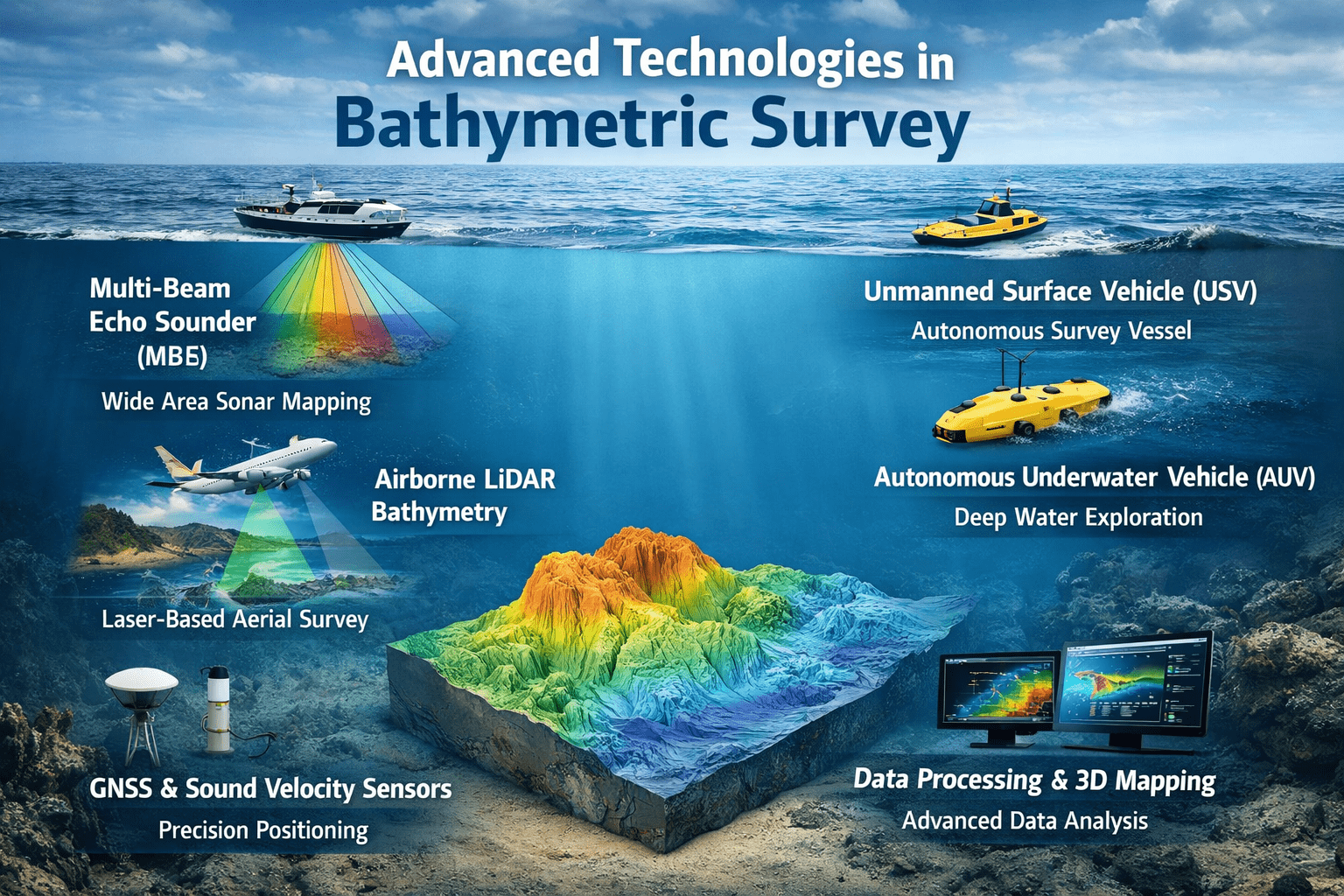
Bathymetric surveys are used to measure the depth and shape of underwater surfaces in rivers, lakes, reservoirs, coastal areas, and oceans. These surveys help in understanding underwater terrain and are widely used in navigation, water resource management, environmental studies, and marine engineering. Over time, bathymetric surveying has evolved from basic manual methods to advanced digital technologies that offer higher accuracy, faster data collection, and better coverage.
Development of Bathymetric Survey Methods
Early bathymetric surveys relied on simple tools such as lead lines and basic echo sounders. While these methods provided depth information, they were limited in accuracy and coverage. As the need for detailed underwater data increased, new technologies were introduced to improve efficiency and reliability.
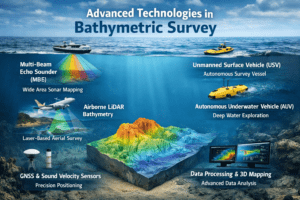
Modern bathymetric surveys now combine sonar systems, satellite positioning, automated platforms, and advanced software to create detailed underwater maps.
Multi-Beam Echo Sounder (MBES)
A Multi-Beam Echo Sounder is one of the most widely used advanced tools in bathymetric surveying. It emits multiple sound beams across a wide area of the seabed, allowing depth measurements at many points simultaneously.
Key characteristics:
- Covers a wide swath of the seabed
- Produces detailed depth and terrain data
- Supports three-dimensional seabed mapping
- Reduces survey time compared to single-beam methods
MBES is commonly used in coastal, offshore, and harbour surveys.
Single-Beam Echo Sounder (SBES)
Single-Beam Echo Sounders measure water depth directly beneath the survey vessel. When combined with precise satellite positioning systems, they provide reliable depth data, especially in shallow or inland water bodies.
Common uses include:
- Rivers and canals
- Lakes and reservoirs
- Small-scale bathymetric studies
SBES remains a practical solution for many applications due to its simplicity and cost-effectiveness.
Airborne LiDAR Bathymetry
Airborne LiDAR Bathymetry uses laser pulses transmitted from aircraft or drones to measure shallow-water depths. A specific wavelength of light is capable of penetrating clear water and reflecting off the seabed.
Advantages include:
- Rapid coverage of large areas
- Suitable for shallow coastal zones
- Simultaneous collection of land and water data
- Reduced need for water-based surveys
This method is often used in coastal mapping and shoreline studies.
Unmanned Surface Vehicles (USVs)
Unmanned Surface Vehicles are remotely operated or autonomous boats equipped with bathymetric sensors. They are especially useful in areas where traditional survey vessels may face limitations.
Benefits:
- Safe operation in shallow or restricted waters
- High manoeuvrability
- Reduced field manpower
- Consistent data collection
USVs are increasingly used in inland and near-shore surveys.
Autonomous Underwater Vehicles (AUVs)
Autonomous Underwater Vehicles operate below the water surface without direct human control. They are designed to collect bathymetric and other underwater data in deeper or complex environments.
Key features:
- Ability to operate at greater depths
- Stable data collection in challenging conditions
- High-resolution underwater mapping
AUVs are mainly used in deep-water and research-oriented surveys.
GNSS Positioning Technologies
Accurate positioning is essential for bathymetric surveys. Modern surveys use advanced GNSS techniques such as Real-Time Kinematic (RTK) and Post-Processed Kinematic (PPK) to improve location accuracy.
These systems help ensure that depth data is accurately referenced to real-world coordinates.
Sound Velocity Measurement
The speed of sound in water varies due to temperature, pressure, and salinity. Sound velocity measurement tools are used to correct depth calculations and improve the accuracy of sonar data.
This step is particularly important for surveys using advanced sonar systems.
Data Processing and Visualization Software
Advanced software tools are used to process raw bathymetric data into usable outputs. These tools help remove errors, apply corrections, and generate detailed depth models.
Typical outputs include:
- Bathymetric maps
- Three-dimensional surface models
- Volume and area calculations
Digital processing improves both accuracy and presentation of survey results.
Integration with Mapping Systems
Bathymetric data is often integrated with geographic information systems (GIS). This allows underwater data to be analyzed together with land features, infrastructure, and environmental data.
Advanced technologies have significantly improved the way bathymetric surveys are conducted. Modern tools such as multi-beam sonar, LiDAR, unmanned platforms, and advanced positioning systems provide accurate and efficient underwater mapping solutions.
As technology continues to develop, bathymetric surveys are becoming more reliable, accessible, and adaptable to a wide range of applications, supporting better understanding and management of underwater environments.